

A Financial Therapist Explains Financial Wellness at Work
What You Need to Know About Financial Wellness At Work
It’s a Whole-Work thing: Financial wellness at work happens at every level, individually as teammates, and through leadership.
PTO Matters: How people use, or don’t use, their PTO is one of the clearest clues about what’s actually working.
Cultural Impact: Leaders set the tone by rewarding real well-being, modeling boundaries, and making money conversations safer.
What Financial Wellness In The Workplace Is
Most workplace money conversations focus on financial knowledge, things like how to budget or why a 401k matters. And those things absolutely matter, but financial wellness goes a layer deeper than financial literacy.
Financial wellness at work means not just understanding the ins and outs of money, but feeling safe enough to ask for clarity and having a culture that invites people to be financially well.
The workplace is full of small financial moments that highlight how financial wellness is being tended to, or not, at work. Things like what an individual worker does when they get their annual HR benefits email, or what the workplace norms are around going out to eat.
If we want to feel better about money at work, we have to pay attention to those moments of financial interactions, not just the big, obvious ones.
Individual Wellness Actions
At the individual level, there are four key ways you can practice financial wellness at work. They are moving from avoidance to action, understanding your compensation, boundary setting, and taking your breaks.
Action instead of Avoidance
Financial anxiety at work can look like avoidance or procrastination. Instead, take small actions to engage with money-related tasks you’ve been putting off. This helps build momentum and strengthens your trust in yourself. This can look like often looks like engaging with the things you’ve been putting off.
Things like submitting your expense reports, opening benefits emails from HR (instead of flagging it for “later”), and asking your coworker for clarity on how to access professional development funds.Understand And Take Advantage of Your Full Compensation
Make sure you fully understand your compensation, not just your salary or hourly rate. Make sure you understand things like retirement matching, insurance options, time off like PTO, sick days, floating holidays and access to stipends or professional development funds.
Once you understand what’s accessible to you, make sure you’re actually using those benefits.Financial Boundary setting
Learn how to say no to things that aren’t in the budget–or not a priority–for you. Have a response ready for things like going out to eat or politely turning down buying another box of cookies. A couple of examples are here:
“I’m skipping takeout this week—want to do a brown bag lunch instead?” “ or I’d love to support that fundraiser, but I already did my giving this year.”Take Your Breaks
Take your lunch (away from your computer). Take a 15-minute pause or stretch break. Take your PTO. And not as a reward, but as a baseline.
When we skip breaks, we’re often (subconsciously) trying to prove our value or anxiously worried that we haven’t “deserved” that time off. Over time, that tells our nervous system that rest isn’t safe.
Taking all of your breaks is a way to practice financial wellness. It reinforces that your time, energy, and well-being matter.
Team Level Financial Wellness
Zooming out a level, your workplace culture isn’t created by policies alone, it’s created in everyday interactions.
Give people the benefit of the doubt (and say the thing kindly)
Instead of passive-aggressive Slack messages or silent frustration, try direct but kind communication.
For example:
“I can see you’re excited to take on more projects, and I also noticed a few things slipping through the cracks. How can we support you here?”
This helps create a culture of support and emotional awareness, which can strengthen workplace financial wellness.
Be mindful of money gossip
When water-cooler talk starts turning into whispers about how someone afforded their latest vacation, it can create a culture of gossip. This financial gossip can invite financial comparison, shame, and jumping to conclusions about your teammates. If you notice it happening, you can redirect the conversation or opt out altogether. Better yet, is to create a culture where kind and open curiosity is fine, but snarky, judgmental gossip isn’t allowed.
Connect without spending
So much “workplace bonding” revolves around spending money. Happy hours, group dinners, and coffee runs come to mind. But there are other ways to connect, and being on a team means you can advocate for alternatives.
That looks like:
Inviting people without pressure, “We’re grabbing lunch if you want to join!”
Offering alternatives like walks, coffee, and bring-your-own meals
Not teasing or questioning someone’s choice to opt out
Turn Caring into Action at the Leadership & HR Level
If you’re in a leadership or HR role, you have a different kind of influence. You’re shaping what gets normalized, rewarded, and reinforced. One of the biggest gaps I see is between intent and impact. You care about your team and want them to feel financially supported at work, but it’s important to move beyond saying you care and shift into something people can actually see.
Impactful Rewards
A pizza party or team lunch might have worked at one point in time, but now it can feel like an empty gesture (see: Severance melon parties). Instead, think about rewards that respect people’s time and energy:
an extra half day or day of PTO
a “fun fund,” where the team gets to vote on how they spend their earned reward
a standing “first Friday off” each month
Create a PTO award. Yes, really. Recognize and celebrate people for actually using their time off.
What gets rewarded gets repeated, and right now, too many workplaces reward overwork.
2. Normalize talking about money
Many employees have questions about benefits, PTO, or compensation, but don’t ask because they’re worried about how it will look.
As a leader, you can normalize talking about money by:
bringing up financial resources throughout the year, not just onboarding
Responding to questions about benefits and compensation with clarity and care
Scheduling webinars, retreats, and lunch and learns that cover topics like financial well-being.
3. Ensure Breaks Are Used
If you can’t change policies like PTO or compensation, make sure people are actually using what’s available to them.
A former supervisor of mine gave great advice. They said, “Check your team’s PTO.” Meaning, actually look at how much time people are taking, and not taking, to get a sense of their overall well-being.
Checking your team’s PTO gives you great insight and opportunities to check in. A couple of times per year, run a report to see who is close to running out of PTO and who hasn’t used much at all. Both ends of the spectrum need to be reviewed. And for the folks in the middle, it’s worth checking in to make sure they actually feel like they get their breaks when they take them.
For the person who is running out, touch base to make sure they’ve got what they need. See if they need to tap into the collective PTO bank if your work offers it, or if they need flexibility in their schedule.
For the person who isn’t using it, gently encourage them to do so. Remind them that no awards are given for burnout.
4. Do What You Say: Model Boundaries
If you’re telling your team to take breaks but never take one yourself, they’ll follow what you do, not what you say.
When you log off at a reasonable time, take your vacation, and respect boundaries, you’re showing your team that financial wellness at work is the norm.
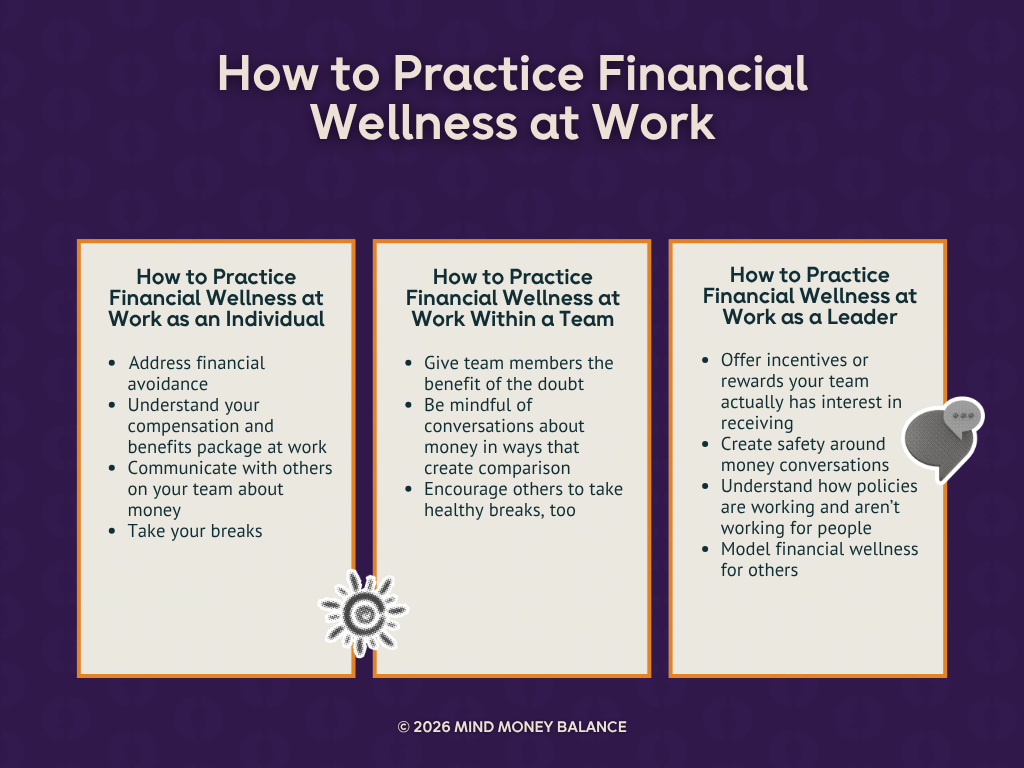
Takeaways: Financial Wellness at Work
Financial wellness at work isn’t a one-time thing. But you can plant the seeds and nurture them with things like creating a culture of work-life balance, reducing workplace gossip, and taking small actions to overcome financial avoidance.
When people feel safe, supported, and respected in how they interact with money at work, things shift. Overall well-being and productivity improve.
If you want help identifying and untangling financial anxiety in your workplace, this is the kind of work I love! I partner with teams and leaders to help them identify how financial anxiety shows up at work, and ways to dial it down to support real, holistic, financial wellness at work.
If you like these ideas and want to bring in some financial wellness to your workplace, consider hiring me for financial therapy-informed wellness. I work with brands, conferences, and workplaces, tailoring financial wellness content to each audience’s needs