

How Financial Anxiety Shapes Workplace Behavior
What You Need to Know About Financial Anxiety at Work:
Financial anxiety doesn’t stay at home. It shows up in your boundaries, your team dynamics, and workplace culture.
Financial stress symptoms can look “productive.” Things like overworking, taking on additional responsibilities, and a constant need for reassurance could be signs of financial anxiety.
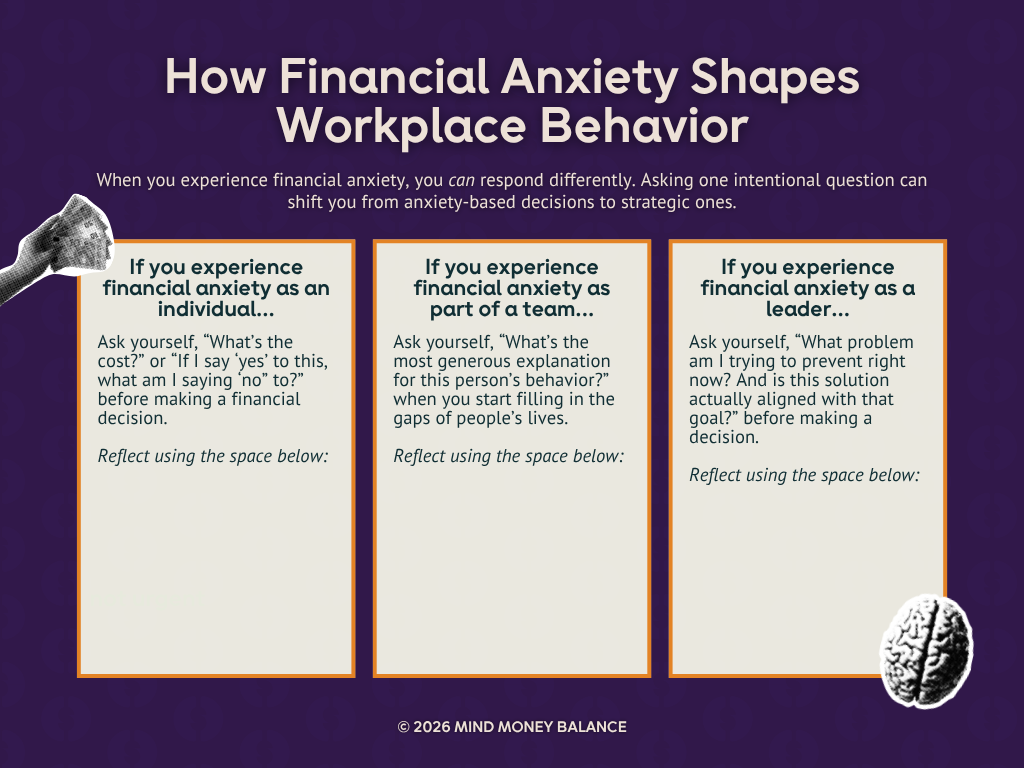
You can respond differently. Asking one intentional question can shift you from anxiety-based decisions to strategic ones.
Financial Anxiety at Work
Research consistently shows that financial stress symptoms can include sleep disturbance, irritability, fatigue, difficulty concentrating, as well as physical manifestations such as aches and pains or high blood pressure. Now layer that onto your job.
Financial wellness at work isn’t a “nice to have” perk for the benefits-rich few. Money is already influencing behavior, communication, and decision-making, even if we aren’t labeling it that way. Plus, employees expect workplace financial wellness support: more employees are expecting their workplaces to provide financial support, whether through investing help or access to financial therapy.
Sometimes, financial anxiety manifests as “odd” behavior in individuals. Sometimes it looks like team pettiness. And sometimes it looks surprisingly productive, like employees overworking and asking for additional responsibilities.
But when financial anxiety at work goes unnamed, it doesn’t disappear. It shapes personal decisions, impacts team dynamics, and can influence workplace culture. However, learning to identify it and ask the right questions can help shift things.
This shift can create space for individuals to understand their relationship with money, give teams a way to be gracious to their coworkers, and help leaders in charge of culture nurture healthier workplaces.
In this blog, I’ll cover how financial anxiety might manifest for an individual, how it impacts a team, and how it can ripple through leadership, creating a positive culture of workplace financial wellness.
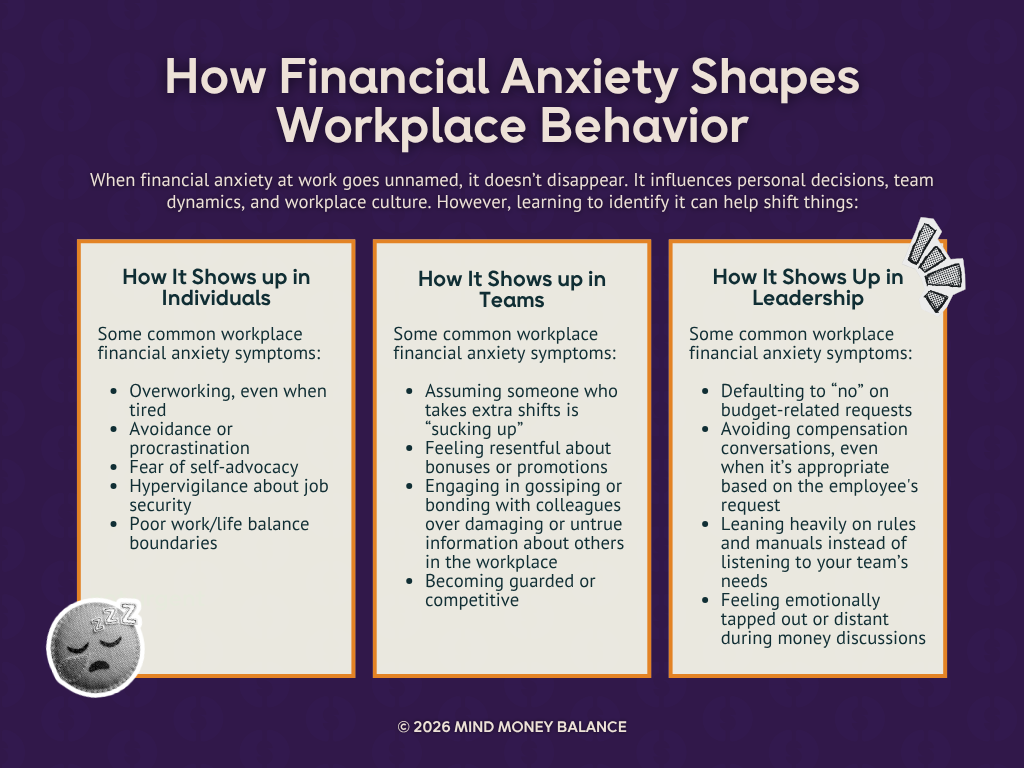
Financial Anxiety at Work: How It Shows up in Individuals
Financial anxiety at work doesn’t always show up as withdrawal or worry. Often, it shows up as overworking. This complicates things: you might even get positive reinforcement for your behaviors. Your boss thanks you for taking on more responsibilities, or your coworkers admire your responsiveness, even on nights or weekends. They can’t see that what’s driving the behavior is money stress.
Here are some common workplace financial anxiety symptoms:
Overworking: This can look like saying yes to extra shifts, or taking on additional responsibilities, even when you’re exhausted, because you’re worried about what might happen if you say no.
Avoidance: Putting off financial tasks that impact your personal finances, such as avoiding submitting expense reports or mileage reimbursement requests.
Fear of self-advocacy: Staying in a job that you don’t like because the idea of change feels financially risky.
Hypervigilance about job security: Similar to overworking, seeking feedback from your supervisor about your job stability, even after they’ve provided reassurance or you’ve taken on additional responsibilities.
Poor work/life balance boundaries: Responding to Slack messages on weekends, or replying to emails when you’re out-of-office autoreply is on because of anxiety.
Procrastination: Putting off workplace financial wellness tasks, such as enrolling in a 401k plan or attending a financial wellness lunch and learn.
The question to ask:
“What’s the cost?”
Instead of “how much more money will I earn,” ask about the drawbacks. What’s the cost of this level of work productivity? Taking on another shift? Not advocating for your needs?
What might you be saying no to when you say yes to more work? Energy? Relationships?
Asking yourself this deeper question might help you find the balance between overworking and burning out. Maybe after this self-reflection, you find that it is worth it to work an extra shift or two a month, but it’s not worth your physical health or the negative impact on your relationships to pick up extra shifts each week.
Financial Anxiety at Work: How It Shows up in Teams
Financial anxiety at work doesn’t just shape individual behavior; it also shapes workplace culture.
Most of us keep parts of our personal lives private. We don’t bring our full selves to work, and we rarely have the full story for why a colleague is acting a certain way. Without a complete story, our brains fill in the gaps.
When financial anxiety symptoms go unnamed, they can morph into workplace tension. You might not know that your colleague is picking up overtime because they’re supporting a parent. Or rebuilding savings after medical debt. Or simply feeling financially insecure in ways they haven’t processed yet.
Without that context, it’s easy for financial anxiety-related behaviors to get interpreted in a less generous way. Because we don’t talk openly about money, let alone our relationship with it, at work, these assumptions can shift team vibes quickly.
Someone else’s financial stress might get reinterpreted through a not-so-generous lens. And that interpretation can look like:
Assuming someone who takes extra shifts is “sucking up”
Feeling resentful about bonuses or promotions
Engaging in gossiping or bonding with colleagues over damaging or untrue information about others in the workplace
Becoming guarded or competitive
The Question to Ask:
What’s the most generous explanation for this person’s behavior?
How Financial Anxiety Shows Up in Leadership
If you’re in a leadership role as a manager, boss, or in charge of HR or workplace culture, it’s so important that you know how financial anxiety can show up in two major ways. First, it might be your own financial anxiety that's affecting how you make money-related decisions. And second, you might not know how to identify or support an employee who’s experiencing financial anxiety.
Let’s start with how it can look when a leader is carrying their own financial anxiety. This might look like:
Defaulting to “no” on budget-related requests
Avoiding compensation conversations, even when it’s appropriate based on the employee's request
Leaning heavily on rules and manuals instead of listening to your team’s needs
Feeling emotionally tapped out or distant during money discussions
On the outside, this can look responsible or feel like you’re asserting control. But internally, working on your own financial anxiety can strengthen your ability to create a healthy workplace culture where employees thrive and want to stay for the long haul.
If employees are experiencing financial anxiety at work and a leader doesn’t know how to spot it, they might interpret their behaviors as something else. Something like disengagement, poor performance, or an inability to execute without being micromanaged.
And without getting clear on what’s happening, that anxiety–a leader’s or employees'–can translate into rigid policy. Policies or reactions could look like strict PTO expectations or rigid work-from-home tracking and surveillance.
A Question for Leaders
“What problem am I trying to prevent right now? And is this solution actually aligned with that goal?”
That pause creates space for a strategic response instead of a harried reaction.
Financial Support Examples at Work
Once we can spot financial anxiety across these three workplace levels, the next step is to think about the type of financial well-being support you can offer.
Here are some examples of financial support at work. If you’re an employee, start small by practicing asking yourself the question from earlier, “What’s the cost?”
If you’re a leader, do a quick check to see which types of financial well-being support you’re offering.
Need some ideas? Here are some financial support examples that fit into financial wellness benefits at work:
Workshops that help individuals identify financial anxiety and learn about financial wellness
Flexible PTO policies that acknowledge burnout in addition to life maintenance (doctor, dentist, etc) needs
Workplace emergency fund contributions or access to employee relief funds
Financial wellness at work doesn’t mean solving everyone’s money problems. What it does mean, however, is creating an environment where financial stress isn’t negatively impacting behavior and policies.
If you want help identifying and untangling financial anxiety in your workplace, this is the kind of work I love! I partner with teams and leaders to help them identify how financial anxiety shows up at work, and ways to dial it down to support real, holistic, financial wellness at work.
If you want to work with me more directly, consider hiring me for financial therapy-informed wellness. I work with brands, conferences, and workplaces, tailoring financial wellness content to each audience’s needs