

ADHD at Work (and How It Impacts Your Money)
What You Need to Know About ADHD at Work
ADHD isn’t a deficit of attention: it’s about how your brain regulates attention, time, emotions, and motivation.
ADHD brains are creative, wired with energy and enthusiasm, and can offer strengths and gifts to the workplace.
Grit isn’t the answer. Support is about building systems that actually work with your brain, not against it.
What Is ADHD?
ADHD (Attention Deficit Hyperactivity Disorder) is a neurodevelopmental condition, which means it’s persistent, makes it difficult to function, and shows up across multiple areas of life—work, home, relationships, and school.ADHD isn’t really a deficit of attention; it’s that the attention is hard to regulate.
ADHD affects parts of the brain, including the prefrontal cortex and amygdala. These areas of the brain responsible for emotional regulation, working memory, and cognitive flexibility. Long thought of as a disorder that only impacted kids, the tides have shifted, and we’re now seeing how the symptoms morph in adulthood.
ADHD is also relatively common; estimates are that between 5-10% of the population has the disorder.
What ADHD Can Look Like at Work
A list of ADHD symptoms or traits doesn’t mean much on its own. In this section, I’ll share a typical ADHD symptom, plus how it might show up at work and impact a person’s financial well-being.
Disclaimer: Most of us will recognize ourselves in pieces of this, with or without an ADHD diagnosis. In today’s hyperconnected world, with workplace pressures coming at us from all hours of the day, we are bound to misplace things or struggle regulating our emotions. That doesn’t automatically mean ADHD. If you think you may have ADHD, please seek a mental health diagnosis.
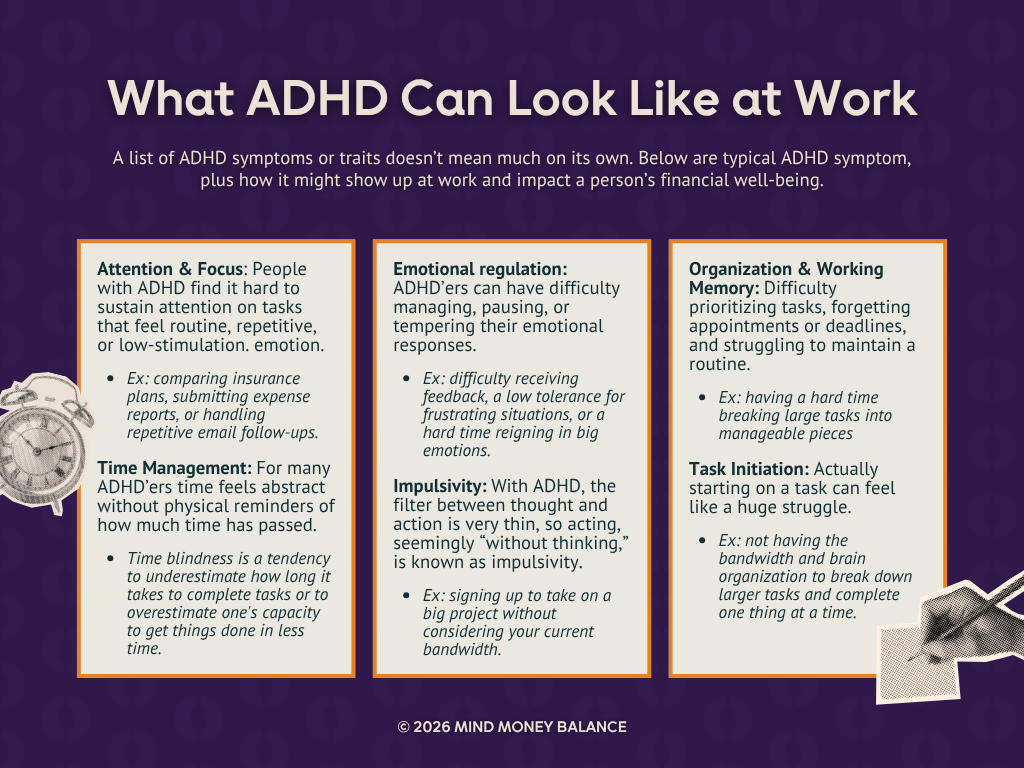
Attention & Focus: People with ADHD find it hard to sustain attention on tasks that feel routine, repetitive, or low-stimulation. emotion.
At work, that could include comparing insurance plans, submitting expense reports, or handling repetitive email follow-ups. These types of tasks are hard for an ADHD brain to hold onto.
Time Management: Time blindness is a tendency to underestimate how long it takes to do things or to overestimate one's capacity to get things done in less time.
With ADHD, the time management struggle is real. For many ADHD’ers, without a physical reminder of how much time has passed, time feels abstract. They can make it feel like deadlines came out of nowhere.
Emotional regulation: ADHDers can have difficulty managing, pausing, or tempering their emotional responses. “I’ve got hurt feelings, I’ve got hurt feelings.” (Fellow Millennials, please tell me you get that niche New Zealander reference!).
At work, struggling with emotional regulation can look like difficulty receiving feedback, a low tolerance for frustrating situations, or a hard time reigning in big emotions.
Impulsivity: With ADHD, the filter between thought and action is very thin, so acting, seemingly “without thinking,” is known as impulsivity. “Hyperactivity” that we might see in a child with ADHD can look like restlessness or irritation in adults.
As an adult in the workplace, impulsivity looks more like jumping in to share your thoughts while a colleague is still talking, or signing up to take on a big project without considering whether or not you have the bandwidth to do so.
Organization & Working Memory: Difficulty prioritizing tasks, forgetting appointments or deadlines, and struggling to maintain a routine.
In the workplace, this can look like tasks taking longer than they need to because items are misplaced or cluttered, or because people have a hard time breaking large tasks into manageable pieces.
I’m going to tell on myself here: If you saw my desk, you might be like, “Ma’am. What is going on here?” It’s a hodgepodge of sticky notes, stacks of paper, scribbles in a physical planner, and most likely, there’s a timer going off somewhere.
To a neurotypical person, it might look messy and chaotic. But to me, it is a physical reminder of how many layers I have in place to not forget things.
Task Initiation: Actually starting on a task can feel like a huge struggle. Because of some of the symptoms I mentioned above, like difficulty with focus and struggles with time management, initiating a task is hard for many ADHDers.
At work, this can look like someone with ADHD doesn’t care about a new project, but they simply don’t have the bandwidth and brain organization to break it down and do one thing at a time.
How ADHD Symptoms At Work Can Ripple into Money
The traits of ADHD I shared above definitely have a knock-on impact on money.
With struggles from time management to task initiation, here’s how it might affect work and money:
Putting off invoices or billing
Missing deadlines tied to reimbursements
Avoiding money-related tasks that feel overwhelming (like choosing an insurance provider or enrolling in a retirement plan)
These might seem like small issues, but they impact how and when you get paid.
Outside of task-based impacts, having ADHD at work can also impact how your work gets tracked or how reliable you appear to others. This perception can affect performance reviews, promotions, and rewards. I’ve seen highly qualified workers passed over for promotions or leadership roles because they were deemed “too emotional.”
The ADHD Strengths in the Workplace
People with ADHD have many strengths that can absolutely be powerful in the workplace. ADHD brains are creative, wired with energy and enthusiasm, and when something catches their attention, they can enter a state of “hyperfocus.”
More on these strengths here:
Creativity: Their brains make unexpected connections, jump between ideas, and approach problems from angles others wouldn't consider.
For example, this creativity can be a gift in roles like marketing and fundraising (think of all the storytelling!) as well as in roles like copywriting and editing.
Hyperfocus: When someone with ADHD finds work that genuinely grips them, they can produce an extraordinary amount in a short time. If you’ve ever written a paper at 10 pm with a 12 am deadline, you might know the feeling.
Energy and enthusiasm: Because of their depth of emotion, they can also be among the most passionate in the room.
This can help with team morale and excitement when working in a mission-driven company.
Workplace Supports for ADHD
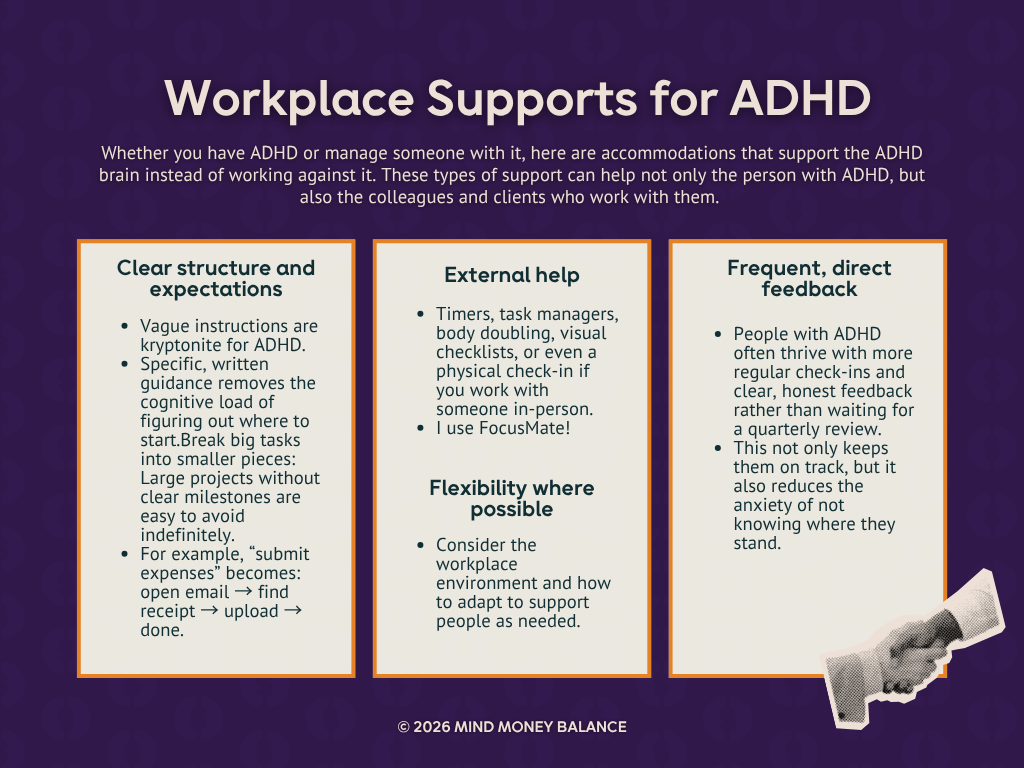
Whether you have ADHD or manage someone with it, here are ways to support an ADHD brain at work. To be clear, these aren’t just “hacks” or crutches; these are accommodations that support the ADHD brain instead of working against it. These types of support can help not only the person with ADHD, but also the colleagues and clients who work with them.
Clear structure and expectations: Vague instructions are kryptonite for ADHD.
Specific, written guidance removes the cognitive load of figuring out where to start.Break big tasks into smaller pieces: Large projects without clear milestones are easy to avoid indefinitely.
For example, “submit expenses” becomes: open email → find receipt → upload → done.
External help: Timers, task managers, body doubling (I’ve mentioned FocusMate many times before; I find it super helpful!), visual checklists, or even a physical check-in if you work with someone in-person.
Frequent, direct feedback: People with ADHD often thrive with more regular check-ins and clear, honest feedback rather than waiting for a quarterly review.
This not only keeps them on track, but it also reduces the anxiety of not knowing where they stand.
Feedback also provides an “endpoint” for hard-to-see tasks, boosting endorphins and dopamine and making it more likely that another similar task will get done in the future.
It also helps you stay aligned on expectations, so you’re not missing out on raises or opportunities because of unclear communication.
Flexibility where possible: Consider the workplace environment and how to adapt to support people as needed.
Some do better with noise-canceling headphones, others with the background noises of a lively coffee shop.
Remote or async work can actually be easier for some, especially for those with time blindness. It’s easier to hop into a Zoom meeting that’s happening in five minutes than to drive across town to get to the meeting in person.
And if you have ADHD yourself, know that getting diagnosed and working with a professional can be genuinely life-changing. Support, whether through medication, therapy, executive function coaching, or a combination, can make a significant difference.
These supports don’t just make work easier; they can help you follow through on tasks tied to income, visibility, and career advancement or stability.
Final Thoughts on ADHD at Work
ADHD is one of the most common neurodevelopmental conditions in the world, and it's sitting in offices, meetings, and teams everywhere, in-person and virtually. Understanding it doesn't require a psychology degree. It just requires a willingness to look at behavior through a different lens: not "why won't they just focus?" but "what does this person's brain actually need to do its best work?"
When you start to understand how ADHD shows up at work, you also begin to see how it impacts time, money, opportunities, and how people are perceived on their teams.
Takeaway if you have ADHD: Start by noticing one task your brain resists, and experiment with one support from this list.
Takeaway if you support folks with ADHD: Supporting ADHD benefits everyone at work. Take the initiative to open conversations and advocate for practical, inclusive strategies within your team and in the workplace.
If you like these ideas and want to bring financial wellness to your workplace, I can help with financial therapy-informed wellness. I work with brands, conferences, and workplaces, tailoring financial wellness content to each audience’s needs.
More Like This
ADHD and Your Money: Everything you want to know about how ADHD shows up financially
Curious about your money archetype and how it shows up? Take the free Financial Archetype Quiz here!