

66: Thinking vs. Doing vs. Being In Therapy and with Money

Most of us spend our time thinking and doing. Creating to-do lists, thinking about what tasks we'll achieve, running errands, etc. But how much time are we "being?"

Thinking vs. Doing
Most of us have an idea of how it feels to be thinking vs. doing. Thinking is the active time spent in your mind. Acts like ruminating, formulating steps for doing things, and considering different options are all acts I'd file under "thinking."
Doing is an active state. It's task-based, has elements of judging, categorizing, and problem-solving. If thinking is creating the to-do list, doing is knocking them off the list.

Doing vs. Being
Doing vs. Being in psychology is often thought about in an "active" state (doing) and passive state (being). However, I think doing and being can be active and passive. I mentioned I view doing as task-based and action-oriented. Being, on the other hand, is the experience of the current moment. There's a non-judgemental feeling and a sense of acceptance. It doesn't necessarily mean stillness; being can also be a relaxed or flow state. For me, going for a walk without headphones is often a state of being. For my artist friends, creating art is a state of being.
Therapist Burnout Recovery
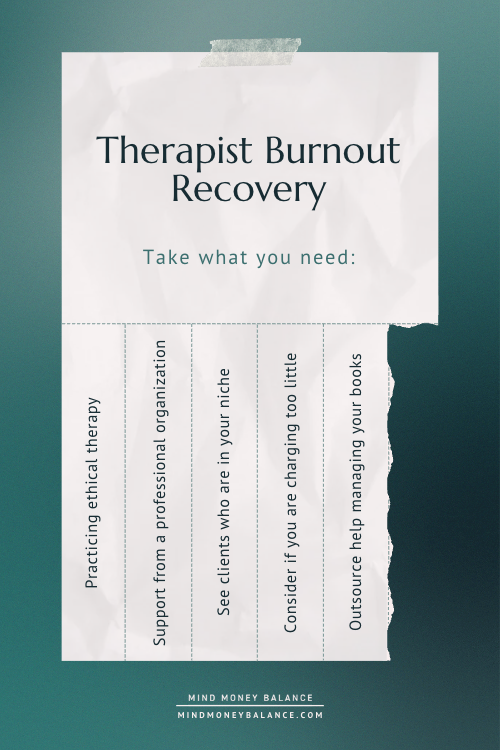
Therapist burnout is on the rise and has been for some time. When prepping for this episode, people search more frequently for "therapist burnout recovery" than they do for "therapist burnout prevention." For me, I think of therapist burnout as being so emotionally exhausted that the therapist is unable to be fully present with their client. Therapist burnout impacts the "in-room" relationship with clients. Burnout also impacts the therapists outside of clinical hours. Burnout can make it hard or impossible to "be;" daily tasks feel insurmountable, and procrastination becomes a regular practice. Tips on therapist burnout recovery often include getting supervision, support from a professional organization, and practicing ethical therapy.
Let's talk about therapist burnout prevention. In my mind, in addition to regular frontrunners like rest, movement, and joy, I'd invite you to include seeing aligned clients and thinking about your money. Stay with me: when you see clients who are in your niche, you are less likely to experience compassion fatigue and more likely to be working with clients you are the best fit for. In other words, if you are excited about who you serve, you'll be a better therapist. I encourage all clients to think about their money. Consider if you are charging too little, paying too much in rent, or need help managing your books. Having your finances in order can decrease stress, and to me, is a measure of preventing burnout for private practice owners.

Being in therapy
As a therapist, "being" in therapy is the state of being attuned, present, and aware of what's happening between the client and therapist. As a therapist, you'll often shift being thinking, doing, and being, but when stressed or on the cusp of burnout, there is likely less "being" happening.
Being with money
What does "being" with money mean? This is a personal experience. I'd invite you to ask yourself what it means for you. Does it mean practicing gratitude for where you are financial? Enjoying a moment of peace while you sip a tea you purchased with your money? Whatever feels right to you, I'd challenge you to see what you can do to bring more being with your money into your life.
Next Steps
If you liked my take on thinking vs. doing. vs. being when it comes to therapists and money, you might be interested in a group coaching offer.
Grow a Profitable Practice From The Inside Out (or "Inside Out") is a money mindset and strategy coaching program for private practice therapists ready to grow sustainable and aligned businesses.
I started my small group coaching program for a few reasons:
There is room for nuance in growing a practice--I don't subscribe to "you must have a FB group" or "you have to be off insurance panels"
Too many therapy coaches and consultants don’t understand the nuances of therapy
I had no interest in creating something massive (I’m a small dinner party kinda gal and wanted to create the same vibe)
After completing Inside Out, participants have:
Increased their revenue by 84%
Confidently shared their therapy niche on their beautiful and hardworking website
Put in their 2-weeks notice at their "day jobs" so they could take their practice full time
Stayed in touch with their peers and continued having conversations about money, business, and their private practices
I believe therapists deserve to be financially compensated for the services they provide in the world, which is why money psychology is a cornerstone of this group.
-
I completely forgot to share with you all that I was getting ready to open the doors for Grow a Profitable Practice From the Inside Out. It is my three month group coaching program. If you are on my email list or follow me over on Instagram, you know that my dog has been pretty sick lately. Um, and that has taken up a lot of my time and energy and it just totally slipped my mind that I needed to let you know.
Things are opening up and by things are opening up, I mean, Grow a Profitable Practice is accepting applications right now. It is the last time I'm going to run this program this year in 2021, and I wanna tell you a little bit about it because A, if you're new here, you might not know what the heck I'm talking about, and B, if you've been here for a little while but you haven't heard about it for a little while, or maybe when you listened to it or read about it last time, it wasn't a good time for you.
I just wanted to do a quick refresher before we get into today's topic, which is thinking versus doing versus being, and I will cover both what those things mean in private practice and also. As a human who engages with money, so Inside Out is something that I created for a few reasons. I believe there's nuance when it comes to growing a sustainable and profitable practice.
I don't subscribe to coaches or consultants who tell you you have to have a Facebook book, a Facebook group, or you have to be off of insurance panels, or you need a TikTok account. I also think too many therapy coaches and consultants don't really understand the nuances of therapy and also I had no interest in creating something massive.
I'm more of a small dinner party kind of gal, and didn't want to create something that was like a big ballroom where you get lost in the shuffle. I'm really getting long winded with that metaphor. Uh, and and past participants have had some amazing results. Um, one participant increased their revenue by 84%, which was just bananas.
Uh, uh, quite a few of them have confidently shared their therapy niche on their beautiful and hardworking website and what a lot of them have that they've stayed in touch with their peers and continued having conversations about money and business and niching and all of that goodness that happens in private practice that quite frankly can be pretty lonely, uh, a lot of the time.
And I really believe therapists deserve to be financially compensated for the services they provide in the world. And that's why money psychology and non-spiritual bypassing money mindset is a corner of this group. I spent a lot of time talking to the folks who end up joining about money mindset, about their financial archetypes, understanding their money, shame.
And then of course we get into the nuts and bolts of how to set your fee, how to adhere to boundaries with your clients, and we transition toward the importance of niching. This time around, we're gonna be covering search engine optimization, something I'm like an evangelist of these days, and every participant who joins gets a beautiful predesigned template from Monica Cova at Hold Space Creative.
So if that sounds of interest to you, I'd invite you to check out everything about the program. I have dates, times, questions about who it's. For who? It's not for. When it's a good time to join everything you could possibly think to ask me, I have answered on a very thorough webpage, go to MindMoneyBalance.com/ProfitablePractice, all one word.
I would love to see your name on the application and help you grow your practice in community with others. Again, that's at MindMoneyBalance.com/ProfitablePractice. And with that, let's shift into today's topic on thinking versus doing versus being. And because I'm in a wordsmithy type mood, I don't think that's the mood.
I want to paint a little picture here. Let's picture this. It is a hot sticky day in August. If you are in North America, , or the Northern Hemisphere, I should really say, that will probably resonate at this time of year. And you have a friend who has a pool. Those are the best friends to have.
And your friend says to you, Hey, do you wanna come over for a swim? And before you can even answer the question, you've got your bag packed, you're heading out the door, and you're heading to their home. And you know this pool, you know it's on the cold side. And you kind of have two options when it comes to getting in the pool.
So I want you to think about, are you a I'll dip my toe in and see how it feels type of person? Or are you a, I'm jumping off the diving board. Splashing right in type of person. either way. What often happens when you like dip your tone and then pull it out or jump right in, is you have this like physical shock reaction to the coldness of that pool.
So you might dip in your toe and be like, oh my gosh, I'm getting outta here. Or you might jump in or dive in and be like, that water took my breath away. I'm getting out, right? And, and the reason for this is neither of them has really allowed their body to acclimate to the cold water. But a stairs enterer, on the other hand, gives their brain and body time to acclimate to the water.
So, as I mentioned, a stair enterer gives their brain and body time to acclimate to the water, as in they step on a step or a stair, whatever you wanna call it. And they're like, oh, my toe is cold. My foot is cold. But they're gonna take a few breaths, let their body acclimate, and then add their other foot.
Then once that foot acclimate, they take a step down and the water comes up to the calve. And the same thing. They have to kind of regulate their breath, but they move down the stairs and they repeat, and they get used to slowly steady. Getting into the pool without that shock to their system. And I know I've talked about bad coaches or red flag coaches in the past, and I think a lot of the red flag coaches embody this idea that everyone's a toe dipper and going too slow.
And if they can just encourage a canon ball approach, it'll fix them. And my point is that either way, if you're toe dipping, you're leaving the pool. And if you're canon balling, you're shocking your system. So that's not my approach to coaching or to what we're talking about today on thinking versus doing versus being.
The reality is most people need to be exposed to things slightly outta their comfort zone and acclimate before moving deeper. So if you're a mental healthcare provider and you've started listening to podcasts or following people on Instagram or TikTok or wherever you're getting your news, you might hear a lot of these.
Coaches who are telling you like, just canonball in and it'll fix you. Right? It sounds like: Three extra prices, who cares? Go bigger, go home! Pay in ads! Go live on Instagram every day! Right? All of that stuff. So I led with that little anecdotal story because I think it's important to set up. Thinking is a lot of what happens when we dip our toe and leave the pool or, um, when you do, you jump right into the pool, but you haven't spent any time thinking about it.
And being is the slow stair stepper being, if you're into meditation, which I try to practice, but I will be totally honest with you that it's really hard for me to do is the idea of being just here! Here in the right now, this very moment as you listen to my voice in your ear, here. The space that is nonjudgmental full of acceptance and full of five senses present.
Now, it doesn't necessarily mean stillness. Like I mentioned, meditation is a little bit tricky for me, but it can be what we would call like a relaxed state or a flow state. For me, I feel like I get into being mode when. On a walk without my earbuds and taking in my surroundings or, um, for my friends who are artists for them, they, they describe it when they get into that flow state when they're creating something.
Right? It doesn't mean just crossing your legs and, and chanting to be in being mode. It really is just being in the present. And as therapists or healthcare providers that work with individuals or couples or groups, being is when we are just listening and accepting and in the presence of our clients.
Whereas thinking is like considering and ruminating. And, and it might also be introspective too, but it's, um, it might be introspection too, but it's also about like formulating steps, creating a plan, making your to-do list, evaluating, creating, um, evaluating what's working, what's not. So it's, it's about kind of the preparation and then doing is very task based, right?
It's getting from point A to point B. It is judging things not in a negative way all the time, but just like taking stock of, of what's happening, categorizing things, problem solving things. And, and the reality is, I'm not here to say like, you have to be in being mode all the time. I don't think that's possible.
And maybe some of you meditative folks are gonna be like, no, Lindsay, it is. But anyway, I digress. I think we need a combination of all of these. I think we need thinking. I think we need doing, and I think we need being when it comes to being private practice owners, but I think what happens is that so many of us get stuck in either the thinking or doing that we aren't being in our practices, meaning we're thinking things like, should I raise my prices?
Should I get a physical office? Should I offer teletherapy? Should I get another? Um, certification, right? We're thinking, thinking, thinking, thinking, thinking. The doing is the tasks. I'm going to write an email, I'm going to create a blog post. I'm going to see five clients and check that off of my to-do list.
And then being is just noticing what is coming up in your practice. And for me, I think that it is possible for you to have more of that being mode. When you are fully in charge of your practice in a way where you are financially supported. So if you are safely in a place where you can like sit down or jot down these notes, I want you to really, I want you to write down how will things look and feel.
In my private practice when I call the shots, because right now your thinking self might be calling the shots. Your old colleagues might be calling the shots. You might be still working full-time or part-time at a hospital or a school or um, in a university setting. Maybe they're calling the shots. So write down how will things look and feel in my private practice when I'm calling the shots.
And I want you to, to just mindfully practice being in your private practice. And if you're spending a ton of time in your private practice, in the thinking stage or in the doing stage, you might need to shift some things around. And I wanna remind you that you have gotten to where you are as a private practice therapist or as a therapist who's on the edge of moving into private.
You have a lot of evidence that you are able to think and you are able to do right? That is how a lot of us get through things like graduate school and internships and additional certifications. You have all of those thinking and doing skills. The being in your private practice might feel a little bit out there, but I believe when we have more being mode on in our private practices, especially when we are seeing aligned clients who are in our niche, who light us.
You get to be a better clinician because we all know that when we are in a session with a client, we might be sitting across from them either in person safely or on Zoom, depending on when you're listening to this, and we're all running through those two stages. We're thinking, we're doing, we're thinking we're doing, but how often are you being with your client?.
How often are you not judging, accepting what's happening and just fully being present for your client? And it also can be this creative state, right? Sitting across from them literally, or over zoom and thinking in a way that isn't about ruminating and formulating and to dos and evaluating and all those things.
It's about just like embracing that. Does that make sense? I hope it makes sense. It makes sense in my head. And then when I say it out loud, I'm like, have I totally lost everybody? ? I don't know. Let me know. Tag me on Instagram @MindMoneyBalance and let me know if you understand what I'm talking about with this thinking versus doing versus being.
And when it comes to money, we also do this, right? We think I should be saving for my future. I think I am going to negotiate a raise. I think I'm going to leave my job and get a new one. Right? We think about money a lot, and then we do a lot of things with our money, right? We spend, we lend, we loan, we um, we engage with our money a lot.
We put our money into spreadsheets. We read podcasts like we're doing. We might read podcast. Maybe you have CC on, uh, you know what I mean? But how often are we actually like just sitting with this idea of what is going on in our financial lives and just being with it in a nonjudgmental way?
And again, if you're like, what are you talking about? Maybe journal on it. Maybe you need to do a little thinking and doing to just ask yourself, what would being mode mean for me with my money? How would it help me to get into a space where I can be relaxed around my money, where I can get to a space where I'm not judging myself for what I have or haven't done with my money?
Is it possible to use my money in a fun and creative? . So all that to say, there's value in all of these things in thinking versus doing, versus being. But I think our society puts a lot of emphasis on the first two thinking and doing, and not as much on the being. So whether you are in private practice and you're contemplating, you know, really setting up your practice in a way that's allows you to be.
Or you are a, a non therapist human who's listening to this for the, the money and emotional side of things. How often are you being in relation to your money and not thinking or doing? So that was kind of a heady episode. I hope it makes sense. I hope that you can spend some time in that thinking and doing as you reflect on what it would mean to be more present with your money.
And I'll remind you again as we wrap things up, that my group coaching program Grow a Profitable Practice From the Inside Out. Doors are officially open. You can apply to join. Go to MindMoneyBalance.com/ProfitablePractice. Read through, get your thinking and doing down, and then you know, apply if it feels like a good fit.
Thanks so much and I'll see you next week.