

Avoiding Money Scams: How to Protect Yourself Without Shame
What You Need to Know
No one is immune to financial scams. Scammers are skilled at manipulation and people of all ages, races, and socioeconomic status’ are impacted.
Scammers create urgency and confusion to push victims into fight, flight, freeze, or fawn mode, making it hard to think critically. Victim-blaming only makes it harder for people to report and prevent future scams.
If it feels weird, trust your instincts. Whether you get a call, text, or email, step away, breathe, and confirm the claim independently before responding.
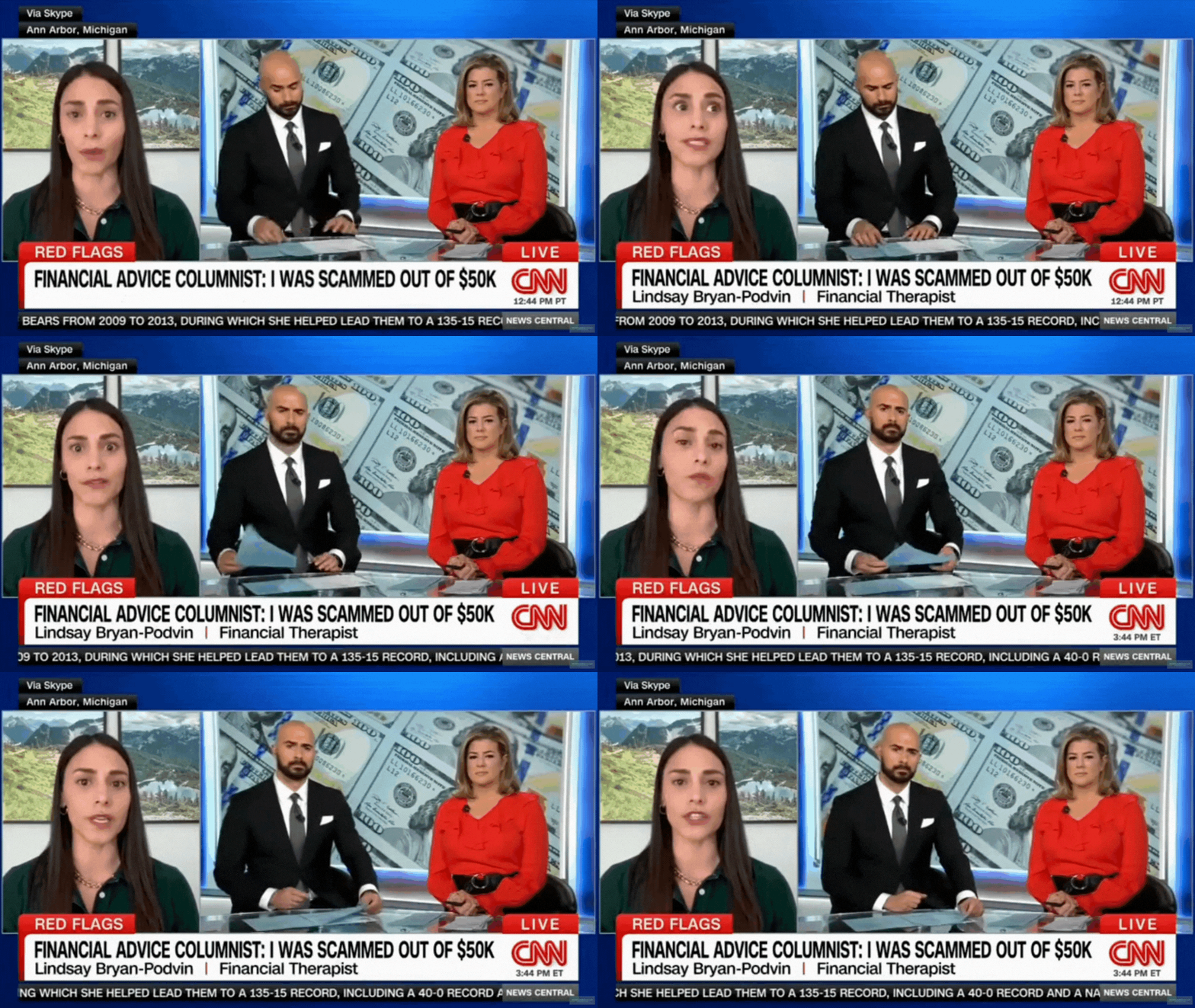
Recently, personal finance writer and journalist Charlotte Cowles shared how she was scammed out of $50,000. Her story went viral, and unfortunately, so did the flood of victim-blaming comments. People were quick to question her intelligence, awareness, and decision-making, as if falling for a scam is something that only happens to "careless" people.
While the reporters wanted easy-to-spot advice on finding red flags, I had to tell them the truth: none of us are immune to financial scams.
The moment we start believing we're too smart or savvy to be fooled is the moment we let our guard down. and scammers thrive on that vulnerability. This is why victims of online scams span all age groups, from seniors targeted through phone scams to Gen Z falling for online scams disguised as job offers or social media deals.
Instead of shaming victims, let’s talk about how these scams work, how they manipulate our nervous systems, and how we can stay vigilant without living in fear.
Financial Scams Are More Common Than You Think
If you think scams only happen to seniors getting suspicious calls from the IRS, think again. While avoiding scams for seniors is important, younger generations are prime targets. With the rise of deep fakes and AI on social media, to “oops I accidentally sent you money” on peer-to-peer payment apps (Cash App has a brilliant marketing campaign to help you spot these types of scams, I’m sharing the video below) scams happen to people across generations, income brackets, race, and gender.
According to Gallup, in 2023, scams were the most common type of crime reported in the U.S., affecting up to 15% of households. That number is likely underreported because of the shame surrounding financial fraud. When victims are blamed or shamed, they’re less likely to come forward, and the cycle continues.
Victims of online scams are all ages, including Gen Z.
Seniors Aged 65+: 13% report being victims of scams.
Gen Z Aged 18-29: 22% report falling for scams, nearly double the senior rate.
It’s not just individuals impacted by scams. Businesses and organizations fall for scams, too. Phishing emails targeting employees, fraudulent invoices, and fake supplier requests cost companies billions every year. If multi-million-dollar corporations with compliance departments and security teams can be tricked, it’s no wonder individuals are also at risk.
Gen Z Falls for Online Scams
Gen Z is part of the fastest-growing segment of victims of online scams. There are some hypotheses for this. While Gen X and Millennials had explicit education or training on “online scams” and “digital literacy,” Gen Z did not get that. Because they are digital natives, they use technology way more than any other generation. They may be more likely to dismiss “this is the IRS” calls but less savvy when it comes to spotting fake social media ads or DMs for great work-from-home jobs.
Why Are Money Scams So Effective?
Scammers don’t just rely on deception; they use psychological manipulation to push their targets into a fight, flight, freeze, or fawn response. This is what makes common money scams so effective.
When we experience stress, our nervous system shifts into survival mode.
On one end of the spectrum, we feel hyper-alert, anxious, and reactive. This is why scammers often create false urgency (e.g., "Your bank account has been compromised! Act NOW!").
On the other end of our nervous system, stress can make us feel overwhelmed, exhausted, and frozen. When we’re in this state, it can make it easy to comply when someone offers a "solution."
Either way, scammers know exactly how to make us feel too dysregulated to think critically.
Common Money Scams
Common money scams include things that sound too good to be true or to urgent to be real. Scammers take advantage of our trust in authority and technological convenience.
Scams today look more sophisticated than ever. A fake email from your bank might look identical to a real one. A scammer might spoof a phone number so that "Amazon" or "Social Security" appears on your caller ID or in the url from an email they send.
Rather than constantly refresh your feed to stay on top of the latest money scams, it’s better to learn how to reduce your risk.
How to Avoid Money Scams: Without Constant Anxiety
It’s unrealistic to avoid money scams completely, but you can reduce your risk without living in fear.
Here’s how:
Search it. If something feels off, search the scenario + the word "scam." These scams evolve, but so do public warnings. Reddit usually has up-to-date threads on how these scams shapeshift and morph.
Verify before acting. Hang up, ignore the email, and call the company or agency directly.
Check your accounts. If you get an alarming call about your bank account, don’t panic. Log in and check yourself before taking action. NOTE: DO NOT login while you are on the phone or email with anyone claiming to be from your financial servicer.
Slow down. Remember that scammers rely on pushing you into fight, flight, freeze or submit, and they know the best way to do that is to use urgency. If someone demands immediate action, that’s your cue to pause and assess.
Say it out loud. Talk to a friend, partner, or even post in a trusted online forum. If it sounds too wild to be true, it probably is.
Stay informed. Sign up for scam alerts from the Federal Trade Commission (FTC), your bank, or consumer protection groups. Knowledge is power, and being aware of new tactics can help you avoid falling for them.
Train yourself to recognize the emotional manipulation. When faced with an unexpected financial situation, check in with your body. Are you feeling panicked? Do you suddenly feel the need to act immediately? Take a moment to regulate your nervous system before making any decisions.

Get Support if You’ve Been Scammed
If you or a loved one has been a victim of a scam, please know it’s not your fault. Scammers are skilled at what they do, and their tactics are designed to work on even the smartest, most cautious people.
Shame and embarrassment often prevent people from reporting scams or seeking support, but speaking up is crucial. Reporting a scam helps authorities track fraud patterns and prevent others from being victimized. On top of that, hearing from others who have been through similar situations can help you feel less alone, and can be a great place to process what happened without the fear of judgment.
Where to get support:
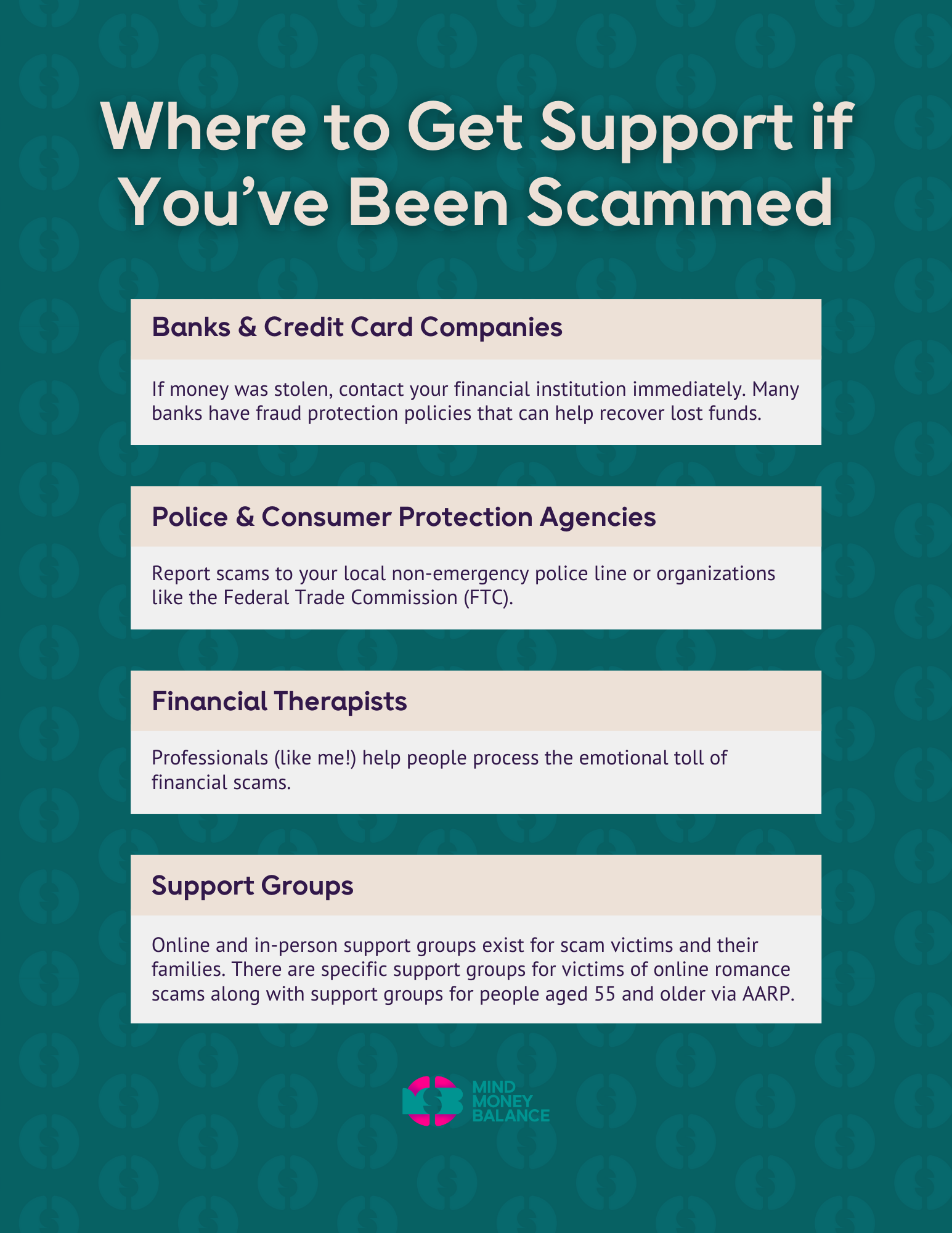
Support Groups: Online and in-person support groups exist for scam victims and their families. There are specific support groups for victims of online romance scams along with support groups for people aged 55 and older via AARP.
Financial Therapists: Professionals (like me!) help people process the emotional toll of financial scams.
Police & Consumer Protection Agencies: Report scams to your local non-emergency police line or organizations like the FTC.
Banks & Credit Card Companies: If money was stolen, contact your financial institution immediately. Many banks have fraud protection policies that can help recover lost funds.
Protecting Your Finances and Emotional Wellness
Avoiding scams isn’t about being the smartest person in the room or tracking every single scam that’s circulating. One of the best defenses against scams is awareness and community. If you learn about a new scam, share it with your friends, family, and colleagues. The more we talk about these issues openly, the less effective scammers become.
The best way to avoid scams is to stay aware, trust your gut, and remember—slowing down can save you thousands and protect your emotional well-being. Stay connected with a community of folks interested in financial wellness by joining the Mind Money Balance Newsletter here.