

101: Taking Breaks To Prevent Private Practice Burnout

Therapist Burnout
Burnout is physical or emotional exhaustion caused by work or labor that makes you feel worn out, drained, and hard to reenergize. When this happens to therapists, it can be hard to be as attentive in therapist sessions, struggle to complete administrative tasks like billing and scheduling, or unwind at the end of the day fully. Therapists and other healers may be at higher risk for burnout due to chronic exposure to other people's pain, heartache, and trauma.
In a past episode on therapist burnout, I shared five things that help me. To summarize, they are hobbies, human connection, financial self-care, and personal self-care. The fifth thing that helps me prevent burnout is boundaries which I'll talk more about next week.
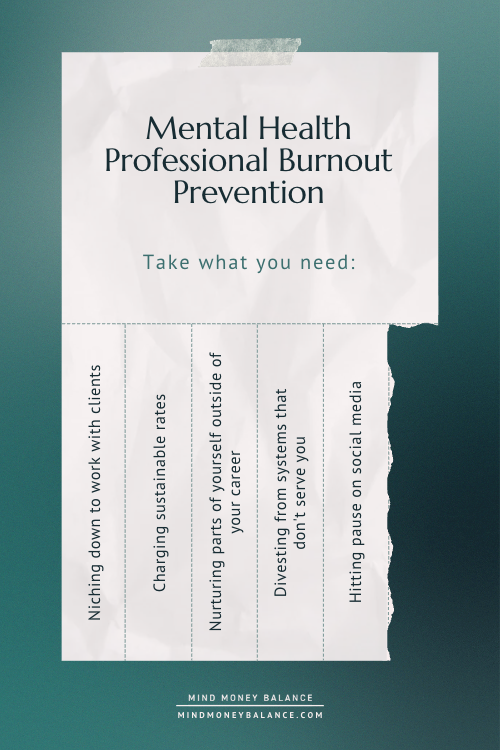
Mental Health Professional Burnout Prevention
Burnout is sadly an occupational hazard for mental health professionals. What helps mental health professionals prevent burnout can vary from person to person, but I find a few things show up repeatedly.
As a coach for therapists in Grow a Profitable Practice From the Inside Out, there are four things I see help with burnout prevention:
Niching. Niching is when a therapist narrows down who they work with or what type of work they perform. A therapy niche is a focused, targeted group or type of person you know how to help. When you niche down in your therapy practice, you reduce the likelihood that you'll start in therapy with a client who isn't the best fit for you. By niching down to work with clients who light you up, it is easier to show up as your therapeutic self. I have an entire post on how niching down can help you get more clients and prevent burnout here.
Charging sustainable rates. When we charge sustainable rates–a fee that allows us to cover our personal and business expenses with plenty leftover–it allows us to reduce the number of clients we see. Additionally, charging a sustainable rate means that you include yourself in financial and economic justice (yay! More practicing what you preach!)
Nurturing parts of yourself outside of your career. This means leaning into hobbies, activities, and people that bring you joy, rest, and fulfillment. No one thing should be the sole source of our happiness (and conversely, can cause a lot of stress). When therapists nurture their non-therapist selves, they can recharge themselves, so they decrease the risk of burnout.
Divesting from systems that don't serve you. You likely left your hospital, nonprofit, or school-based job because you saw that the parts of the system were fundamentally broken and opted to do things your way. To borrow from AA, control what you can, and let go of what you can't. Ask yourself what other systems you're still following, even if you don't believe in them. For example: how true is it that to be "full time," you have to work 40 hours a week? How much do you believe you need to be a "blank slate" therapist, and how much of it is old psychobabble?

Creator Burnout
As a therapist, you might also be a social media creator who experiences social media burnout. Creator or social media burnout is real and on the rise. The WHO categorizes social media burnout as a "form of occupational burnout." In other words, poor stress management because it's hard to unplug from social media. For people who are creating content on social media, it might also be the thing that unwinds them (known as cyber-loafing) which makes actually clocking out hard to do. And when you're scrolling to relax, you might inadvertently see something that sparks a creative idea for you, and you screenshot or make a note on an idea, and all of a sudden, you're back into work mode.
Another aspect of creator burnout, in my opinion, comes from chronic exposure to trauma. As an Asian woman, seeing things reshared about people like my extended family and me was incredibly traumatic. I imagine the same goes for Jewish folks seeing attacks against Jewish people and spaces. This also happens for Black people every time there is another racist hate crime against a Black person.

Therapists on Instagram
It's so common today for therapists to have an online presence through a website and by having a therapy Instagram account. I'm all for therapists on Instagram–or any other platform they like to hang out on–but it can also become a source of burnout. While therapists should have disclaimers on the Instagram account (e.g., social media isn't therapy, I don't respond to appointment requests via DM, etc etc.) it doesn't stop comments and DMs from pouring in. Even if as therapists, we know we cannot provide therapy over social media, it's hard to robotically respond to someone who DMs you for help with a generic, "please call 9-1-1 or go to the emergency room."
Still, some therapists who don't have social media accuse therapists who have accounts of further contributing to poor mental health. It's widely known that social media can have poor mental health outcomes. However, therapists believe that meeting potential clients where they're at (scrolling on their phones at all hours of the day) is the best way to normalize and destigmatize mental health care.
Taking a Break from Instagram
I shared on a blog post that I took a month off of Instagram in 2021. I ended up taking two months off when it was all said and done. I'll likely take more time off, but what helps me is coming back to let the data do the talking. I review my analytics every month (and teach this as my CEO Day inside Grow a Profitable Practice From the Inside Out) and follow the numbers. Consistently, what drives people to work with me is google. They find a podcast episode or blog post of mine, then follow along with me via my email newsletter and sometimes Instagram. When I find myself getting cranky about Instagram, it's because I'm not using it for the reason I love it, which is to connect with other humans. It's not about the number of likes or saves (though, of course, those numbers can provide some interesting data); it's about connecting with people on the other side of the screen.
To stay connected with me?
The best thing you can do is get on my email list (I’ve put the newsletter form below). That way, if you take a social media break, you can still get updates from me and learn about what's happening in my business. Give yourself permission to log off if needed to help prevent burnout.
-
Well, hello friends. Remember last month in April, when I changed my intro and outro, it was super excited to be doing themed months, well, let me rewind and kind of fill you in on what was going on behind the scenes. So at the time of this recording, it is May of 2022. And this exact time last year, May of 2021, I was feeling like a day-old helium balloon, you know, bobbing along, but like looking a little sad. And I don't remember exactly what was happening. But I was running full speed ahead into burnout town. And let me be really clear that my business was fine. My practice was full, I was financially stable, et cetera. So I was feeling this burnout and I went over onto LinkedIn, and I tapitty-tapped through to apply to some non-mental health jobs, because any mental health care provider could most likely get a job in 0.2 seconds, especially this time last year, the shortage was and if I'm being honest, continues to be very real. So I applied for some jobs. I even got through two rounds of interviews, only to be told I wasn't a good fit. I did some deep soul searching. If you remember this time last year, I deleted Instagram for about a month. And I realized, like, look, I didn't want a job. What I really wanted was spaciousness, the ability to clock out fully at the end of the day, and to not be so fucking on all the time. And you know what? My business could be that way. But I really had forced it to mimic everything I've seen and experienced regarding work in labor. So I took some really proactive steps to build in spaciousness, which included the ability to clock out and not have to be so on. I deleted Instagram temporarily, as I mentioned earlier, and ensured that I wasn't doing one-off things unless they really lit me up it were in alignment with my values and financially compensated me. And I hired help, you know, Liberty Sales has been here since June of 2021. And in for a little while, like summer, maybe into fall, it was really lovely. I was practicing what I preached. And then I started to get bored. I would literally stare at my planner and my computer wondering like, what do I do with this downtime, and I filled it right back up. And that was something like really great for me like yoga or painting lessons or even freaking going for a walk. I filled it right back up with work, because I have been conditioned like most of us have been to really work a full 40-hour workweek and to feel guilty for doing anything differently than that. And so here I am, May of 2020 to one year later doing a very similar thing. I'm actually not looking at other jobs. So take a deep breath, don't worry. But I'm I was like, full speed ahead cruisin' right back towards burnout. So I'm trying something new. I'm trying to cut my content creation in half. That means halving the amount (H-A-L-V-I-N-G not having) the number of podcast episodes that I put out, being really intentional about just spending some more time kind of sharing about the work that I do because I put out a lot of content. I'm inviting in more collaboration. If you are a follower of my blog, you're gonna see some more collaborative blog efforts happening there. And I'm going to be hopping on Instagram like more when I feel like it not when I have to. And that downtime that I'm now going to give myself I booked some voice lessons. So I don't get tempted over schedule myself. I've really learned just knowing who I am and then also with the guidance of my mastermind like you should probably put something that's schedulable I don't think that's the word we use. But something where I feel like I have to show up for it in order to like schedule in my downtime, it's hard it's really hard to take a step back from the things that colonialism and capitalism have forced on us and to be really intentional about doing work that feels good and being okay not working right. So that's what's been going on behind the scenes. That's why I ghosted you here on the podcast and, and it's like to say two things can be true at the same time like my business is going fine. And I still need to actively practice doing less because It's not all sunshine and rainbows as much as people in the online business space will have you say like, oh, like you just do anything and it's great and all glittery all the time. It's like no like, things can be great and challenging all at once. So, thank you for being here. Thanks for being here. While it ghosted you, I know that wasn't super nice of me, you're gonna be hearing me in your ears a little less. And because I totally pulled the plug like at a random time, the cadence of podcasts will be a little weird. I'll be putting up basically two in a row and then we'll get into an every other week cadence. But just because I took a funky amount of time off. It'll be a little weird around here. But if you if you've been here, many you know it's already a little weird.
Anyway, with that, that is why I have a new publishing schedule on the podcast. That is why I ghosted you a little bit. That is why I had to rerecord my new podcast intro and outro. And with that, let's shift into the theme of this month, which is burnout. Okay. Oh, let me say one more thing. May, June, and July are going to have the overarching theme of me talking to therapists and private practice or service based small business owners. It doesn't mean that if you aren't a therapist or aren't a small-based business owner, you won't get something out of this but they are definitely geared towards that. And May's theme specifically, is around burnout. Because seems like May is my burnout time of year. And I'll have to unpack that a little bit more why this is so challenging for me. So anyway, here we are.
Let's talk about therapists burnout a little bit. I'm gonna talk about how to take breaks to prevent burnout in the rest of today's episode. So I shared in a past episode five things that really helped me prevent therapist burnout, I will link it in the show notes. And to summarize, they are hobbies, human connection, financial, self-care, and personal self-care. And the fifth thing that really helps me prevent burnout is boundaries, which I will talk about more in the next podcast episode. So just know that that's coming. But what I have seen when it comes to helping therapists and private practice owners, help them prevent burnout is like some other things, which are niching, charging sustainable rates, nurturing parts of yourself outside of your career, and divesting from systems that don't serve you. So let's talk briefly about each of those. So niching. All that means is saying this is who I work with and for, and this is who I don't work with or for. And if you're crawling in your skin about that, I want to be clear that niching helps you to not only serve your clients better, but helps to reduce burnout, because then when you see clients in your practice, who are aligned with the types of people you want to see, you're more likely to show up super excited to your therapy sessions, and less likely to hope that people no show, right? We've all been there where we have a client or a caseload that just is not in alignment with the type of work that we're really best suited to do. So having a niche helps to prevent burnout. Another thing that really helps to prevent therapists burnout is charging sustainable rates, I wouldn't have my business or this podcast, if I like didn't fully believe this with the entirety of my being. When you charge a sustainable rate, it reduces the likelihood that you will burn out and allows you to fully show up for the clients you are meant to serve. So you must be charging sustainable rates. You cannot be sliding your scale below a minimum viable number. I actually talked about that in Grow a Profitable Practice from the Inside Out. But you have to be making sure that the number of the fee that you are charging is actually working for you. And just a reminder that if you're accepting insurance, that is paying you less than what you would normally charge people that is a form of a sliding scale. I'm not anti-sliding scale, I have a very comprehensive blog post all about how to set up a sliding scale, if that is important to you, that covers it. But you also have to make sure that you are charging a sustainable rate, which is so so important. The other thing that I mentioned that I have shared with you that I'm actively working on is nurturing parts of yourself outside of your career. In therapy, we have been like really taught that therapy and being a therapist that should be the biggest part of our identity and that doing the work that we do should fully nurture us which is just ridiculous. We know when we work with clients, that having multiple interests and having identities outside of our work is so powerful for us. So we as therapists also have to be nurturing parts of ourselves outside of being therapists. So as I mentioned at the top of this episode on why ghosted you all, I'm actively making it a point to nurture the creative side of my body and my brain by taking voice lessons I haven't sung since I was in frickin' High School. I mean, aside from like, singing along to the radio and singing in the shower, I haven't like actively practiced singing and treating my voice as an actual instrument, which sounds really cheesy. But for my singers out there, you know what I mean. So finding what are the things outside of my career that lights me up? Is it going out and gardening? Is it practicing yoga? Is it taking long baths? Is it pulling tarot cards? What are the things outside of your career that nurture you? And that lit you up? And how often are you actively engaging in those things? And these aren't just like about self care things. This is also about making sure you're actively and intentionally weaving in joy into your life. And joy can take many, many different forms. But we want to be nurturing those parts, especially because, as therapists we are on the frontlines consistently, with all the bullshit that's happening in our world, we have to talk about it hour after hour after hour, day after day after day, because all of the things that are impacting all of our lives are also impacting our clients lives, which means that we're spending a lot of time talking about really heavy, really hard things all the time. So we have to make sure that we have healthy outlets for ourselves outside of just what we do. And then finally, to help prevent therapists burnout, divest from the systems that don't serve you. And this is hard. And this is an ongoing process. This is not like something you can easily go up, check. I am no longer engaging in harmful capitalism, like it just doesn't happen. So really think about what are the systems that are not serving you? And how can you actively divest from them? We do not. That could be literally anything from like, oh, I have to work 40 hours a week, we can divest from that belief, all the way to oh, I need to show up as a blank slate therapist, we can divest from that as well. So divesting from systems that are not working for you and are causing you harm. You can say no, you can absolutely say that doesn't work for me. I'm I'm divesting from that. So those are some things. So I mentioned personally things that helped me our hobbies, human connection, financial, self care, personal self care and boundaries. And we'll talk to you about boundaries next week. And then what I found happens to be really helpful for therapists burnout prevention, when I coach people inside grow profitable practice from the inside out, it is niching, charging sustainable rates, nurturing parts of yourself outside of your career and divesting from things that don't serve you.
Now, let's talk about like why I deleted Instagram twice last year for like, more than two months total. It's like, creator burnout. And if you don't know what I'm talking about social media burnout, according to the WHO the World Health Organization, they define as, quote, a form of occupational burnout, unquote. And when we think about occupational burnout, that is, you know, anything that is causing us burnout because of the work that we do. And for people who create social media content, whether it's Instagram posts, Tik Tok, videos, tweeting, creating graphics for Pinterest, all of that is, is labor that we are putting into our work, aka our occupation and can cause occupational burnout. Because it's really hard to clock out of being on or in creator mode, when we create social media content for our businesses, right, because sometimes at the end of the day, we just want to scroll on Instagram or Tiktok, or Twitter just to like unwind, and I know that sounds wild, but like we do it. It's called Cyber loafing. It's kicking your feet up and scrolling and just letting your brain relax. But it's really hard to clock out when you are a creator. Because when you're scrolling to unwind, you might inadvertently see something that sparks like a creative idea for you, or you screenshot a post that's really inspiring, or you make a note about like something that like makes you really excited and you want to do a post on or you want to do a video on and all of a sudden, you're no longer cyber loafing and relaxing you're back into work mode and creator mode. Like it's really hard to turn that piece of creativity off. And another aspect of creator burnout in my opinion, comes from the chronic exposure to potentially traumatizing things. So as an Asian woman seeing things reshard, about people who look like me and my extended family who are being harmed is incredibly traumatic at the time of this recording. I am part Filipino. For those of you who don't know, in the Philippines, they just had a big election where they re elected the son of a dictator. So that is being shared and reshared like crazy right now. And it's really traumatizing for people who have had to flee the Philippines or whose family had lived through that past regime. And so it's really hard to see those things come back up. And I imagine, you know, the same thing goes for other people of marginalized identities, I imagine for people who are Jewish, seeing attacks against Jewish people in spaces is really, really traumatizing. For people who are black every time there's another racist hate crime against a black person. It's being chronically exposed to trauma. And so it can be really hard when you're trying to unwind as a creator as a person who creates on that app, to be seeing these things that are like personally damaging to you. And I won't even get into what's going on for people who have uteruses in the United States right now, like, wow, I have just totally cut back from a lot of my social media usage, because it's just really hard to be on there. And so specifically for therapists, it's really common for therapists today to not just like have an online presence through a website, but to have a corresponding therapy Instagram account. And to be clear, I'm all about therapist being on Instagram or any platform they'd like to hang out on. But it can also become a huge source of burnout. While while therapists have disclaimers on Instagram, things like Don't forget, you know, social media isn't therapy, or PS, if you DM me about like a personal mental health issue, I will basically give you a boilerplate response, I can't provide therapy over DM, it doesn't stop comments in DMs from pouring in. And even though we know we can't provide as therapists therapy over social media, it's really hard to robotically respond to somebody who DMS you with like a request for help to be like, please call 911 or go to the emergency room like it's just really hard to do that even though we know ethically, we have to do that we can't create a therapeutic relationship over a social media platform. So it's really hard as therapists to take that intentional break or to again, just engage in in cyber loafing. And then some therapists on Instagram have gotten a ton of pushback for being transparent about their own mental health struggles. I remember a while ago, there was a therapist who posted that they took medication to help manage their mental health, which is like pretty standard practice for a lot of mental health issues or disorders or whatever language feels best for you, and was met with a ton of blowback. And any rate, they got a ton of pushback from their field about being that transparent. And so it's so hard to know like, what can you share? What can't you share, because on the one hand, it is helpful to destigmatize mental health. And on the other hand, it can contribute to a lot of bad stuff. And then it gets even more complicated because therapists on social media, also know that social media is bad for people's mental health. So it's like how can you contribute to putting stuff out on social media when you know that being on social media can be harmful for people? You know, there are studies that show specifically Instagram being really bad for people's mental health outcomes. There was a study done, I'll link it in the show notes, when I think of it that found that Instagram specifically is really not great for teens' mental health. But at the same time, it's like we know as therapists how beneficial it is to meet people where they're at. And that could be searching on Google for for like help. But it also could be scrolling on their phone at all hours of the day. So you know, somebody scrolling who's feeling really down and hopeless and depressed could see a post about psychoeducation that helps them to see that they're not alone and validate some of their experiences and can actually be really helpful even if they never end up being a client in your therapy room. So it's, it's complicated. I don't have an easy way to say like, here's how to prevent creator burnout or here's how to prevent burnout as a therapist on Instagram. All I can say is what worked for me is literally deleting the app last year and 2021. I took off a full month in May and then I think I took off, you know two or three weeks in August and then I took another two or three weeks off in from December leading into January of 2022. And I'll keep taking time off, it feels really good for me to come back to like really letting the data do the talking, I review my businesses analytics every month. And if you're like, what is an analytic, it's just looking at different data points of your website, of your Pinterest account, of your Instagram account of your click through rates on email--it's any data, where you are putting something out there to see what people are actually resonating with, right. And I teach this inside, Grow a Profitable Practice from the Inside Out towards the end of our time together in the CEO day training, I teach people, here's how to look at your analytics, here's how to actually read them, and here's how to follow the numbers. So you can do more of what works and less of what doesn't. And for me, what consistently drives people to me, is Google. By far and away, it totally overshadows anything that I do on Instagram or on Tik Tok, or anywhere else, they are Googling me. And they're finding me through a podcast episode, because those podcast episodes are kind of categorized on my website or a blog post of mine. And then what happens is they go, Oh, I really like this person, I'm going to join their email newsletter. Occasionally, they find me by way of Instagram. But mostly it's Google. So when I find myself getting really cranky about being on Instagram, or being on social media, it's because I'm not using it for the reason that I love to use it for my business, which is to connect with people on the other side of the screen. Like for me, it's not about the number of followers or likes or saves. Although, of course, that data can provide some really interesting information about what content works and what content doesn't. It's really about saying, Hey, how did you find me, let's connect off of the app. And that could be me connecting with business owners, I have done these really fun, kind of like anti-network networking events for other small business owners that I've connected with on Instagram, I have connected with people whose podcast I've liked on Instagram and found ways to connect with them off of the app. But it's really not about just like, you know, putting up a cute aesthetic post, and that is what makes me happy. It's really about saying, who's on the other side of the screen? And why are they enjoying what I'm doing? And how can I connect with them?
And so if you're, if you're planning on taking an Instagram break, if you're like listening to this, and like, Oh, I definitely need a social media break. Cool, but, and I might be taking a social media break again--I don't know when I do this pretty frequently, where I'll just like delete the app for a few days over the weekend. But if I ever leave social media, more often than not, I'm still connecting with you through email. I know I mentioned, people find me through Google, but they stay connected with me through my email list. So the best thing you can do to stay in touch with me in case I ghost you again, I don't plan on it, but like, let's be clear, we don't actively plan on ghosting people, right? So the best thing you can do is to get on my email list. That way, if I end up taking a social media break, or you end up taking a social media break, because that's what's best for you. You can still get updates from me and learn about what's happening in my practice and in my business, right. So, case in point, people on my email list knew about my podcast break before people who just listened to my podcast, right, the people who are on my email newsletter list, already heard that story about me applying for a job this time last year and ghosting my podcasts because I wasn't going to show up on my podcast be like, Hey, I ghosted you I instead told my email newsletter list: Hey, if you listen to my podcast, you're going to know it hasn't been updated in a couple of weeks. So people on my email newsletter list find out about things more quickly than podcast listeners who are not on my email newsletter list or people who are just on Instagram. So giving yourself permission to log off, if needed can really prevent burnout. And if you want to stay in touch with me getting on my email list is hands down the best thing that you can do and there are a couple of ways to do that. Of course, you can go to my website and scroll down and add your name to my newsletter list. But a more fun way in my opinion of joining that email newsletter list is going to MindMoneyBalance.com/Quiz where you can take a quiz about your money archetype and learn a little bit more about some of the strengths and challenges in each of those money archetypes and all automatically add you to my email newsletter list. So win-win take a quiz, learn a little bit more about your relationship with money and then end up on my email newsletter list. So again, before I wrap it up today, sorry for ghosting you it wasn't really polite and hopefully, you can start taking some breaks if you're finding yourself kind of get on that edge of burnout, and I, again will link that past episode that I've done on how I actively prevent burnout, and also just like doing a little bit more practicing what I preach and in taking a step back from feeling like I have to create all the time, and giving you all the time to digest stuff, because I know for me, as an avid podcast listener, sometimes I just like, can't keep up, like, there are a couple of podcasts that I love, but they put out two a week, and I'm just like, behind. And to be honest with you, there probably won't be a day where I'm just gonna like binge and get caught up listening at like 2x speed, I'm just going to miss out on some of those podcast episodes. So hopefully, for you as a listener, maybe me showing up here a little bit less frequently in your ears can actually be good for you, maybe that'll give you time to digest what I'm talking about and what I'm learning. So if you are going to be taking a break from social media, or from putting out content, like I am good, I love hearing that and let me know DM me and be like, Hey, I'm gonna be deleting the app for a month I love to see it or, Hey, I'm, I'm putting my podcast on a little spring break or summer break. And it's because of you. Let me know, give yourself permission to take time off trust that the people who want to hear from you will continue to find ways to connect with you, and be consistent in a way that feels good for you. So for me, I'm always emailing my newsletter list. And sometimes I'm emailing them to say, Hey, you're not gonna get an email from me for a few weeks, but I'm letting them know, because that feels just like the easiest way for me to stay in touch with you all. So anyway, thanks for being here. Thanks for listening to ways on taking breaks to prevent burnout, why it's so important to delete these apps as needed. And just like review what you're doing. If you're a small business owner, and you're putting out content all over the place, maybe take a look at that data. And is the data saying, yes, it's working for you. And maybe the data is telling you, Oh, honey, your people aren't here. And that's also okay to be like, cool. My people aren't on TikTok, I don't have to be there all the time, or my people aren't listening to my podcast, no harm, no foul, just like, maybe do a little less. So, permission to do less, permission to take breaks, permission to ghost honestly. And when you're ready when you're able, get back out there and do the things that feel good to you and for you. And I'll see you next week and then we'll get into that cadence of every other week. Thanks for sticking around and I'll see you soon.
Transcribed by https://otter.ai