

61: How To Find A Good Business Coach → PLUS 7 Red Flags

When it comes time to hire some outside help in the form of a business coach, the online world can be overwhelming. Is it better to hire someone who is self-taught, or has a certificate? Does their previous work experience matter, or no? What types of things are normal in a contract and what language might be a sign to turn and run? As an online business owner and therapist, I’ve hired and fired business coaches. In my experience, a good business coach can help you with a strategy for your work, shift your mindset in a meaningful way, and help smooth out some of the bumps in the road. On the other hand, a bad business coach can make you question your sanity, wonder if you’ve flushed money away, or accidentally joined the online world of hidden pyramid schemes. Yikes! Tune in for 4 things I look for before making the hire, and 7 things that make me run for the hills.

4 Signs of a Good Business Coach
Nuance in their approach. Yes, they have a roadmap or framework for working with you, but they don’t claim to do cut-and-paste work. This demonstrated they understand the unique needs of you, your market, and your business.
Stay in their lane. They know their scope and are experts in their area, but don’t pretend to know everything about, well, everything. In other words, they are a specialist or at least have enough humility to talk about the businesses they don’t work with or the type of work they don’t do.
Realistic Expectations. A good business coach offers realistic outcomes. That saying, “If it seems too good to be true, it probably is,” comes to mind. Someone promising “6 figures in 30 days,” or for my thera-friends “$10k months without a website” make me do some head scratching. A healthier outcome would be something like “make the income you need,” or “find a way to create a sustainable living.” Less flashy? Sure. Also less room for heartbreak.
Transparent about their experience. They are upfront about what they have done that qualifies them to help you. There’s nothing wrong with working with a new coach—we all have to start somewhere—so long as they are upfront about where they are in their practice.
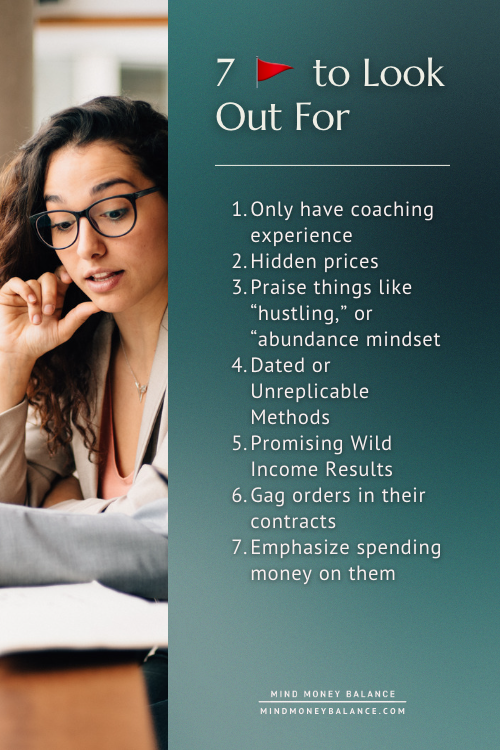
7 Signs to Look Out For
Only have coaching experience. Would you hire a marathon running coach who’d never run a marathon? Probably not. The same goes for coaches. You want someone who understands what you are going through and has been in the trenches. And if not, they at least have transferrable skills or related experience that qualifies them to help you.
Hidden prices. They don’t provide consensual pricing. Instead of transparently laying out their fees, they hide them behind a “discovery call,” where they only disclose the cost to you after they’ve learned what you are struggling with. This is harmful because it puts the client in a position of feeling like they need to work with the coach instead of making an empowered decision to make an investment. The asterisk here is that yes, of course, there is custom pricing that has to be done for custom work, like speaking engagements, day-long workshops, etc. I’m referring to coaches who don’t list their prices to work with them 1:1 or in a signature program.
Praise things like “hustling,” or “abundance mindset.” I read a very popular coach’s business book when I was starting out and remember wondering what I was missing. Why did everyone love this dude? His advice to “should I do X” was an unequivocal “yes.” He mentioned sacrificing sleep, time with your family, and hobbies in favor of being on Tik Tok, Snapchat, Twitter, Facebook, Instagram, and YouTube. Oh, yea, AND SEO-optimizing posts and starting a podcast (Yes AND). A good business coach understands that splitting time eight different ways means a slower and honestly, longer timeline, instead of focusing on 1 or 2 marketing areas.
Dated or Unreplicable Methods. The online business space moves quickly. Someone who is still selling the benefit of creating a Facebook group then trying to get those “community members” to hire you is peddling something that worked in 2014. In internet years, that’s basically 94 years. You need to hire someone who stays on top of what’s working and what isn’t AND helps you set up a business foundation rather than flash-in-the-pan “hacks.”
Promising Wild Income Results. Helping clients make an informed decision about the type of return on investment they’ll get from hiring a coach is helpful. Promising outlandish income results is irresponsible. It preys on the part of our brain that thinks we will be the lotto winner or viral video creator.
Gag orders in their contracts. I’M NOT A LAWYER, THIS IS NOT LEGAL ADVICE. Many business coaches peddling themselves with some of today’s buzzwords (yup, I’m talking “ethical,” “anti-racist” and “feminist” business coaches) put gag orders in their contracts. Seems like the antithesis of an ethical business coach, no? Keep your eyes peeled for “non-disclosure agreement” or “non-disparagement” clauses in your contract. Often those are more palatable ways of saying “you can’t say anything about our work together, even if it was bad, even if it was true.”
Emphasize spending money on them. A red-flag business coach will tell you to rely on FB ads, influencer marketing, or maybe even hiring their "awesome friend" to help you write copy for your website. I'm not opposed to leveling up and paying for support, but having the foundations of a business in place, knowing what methods are working (and which ones aren't) are prerequisites before throwing money out there.
Need Help as a Private Practice Owner?
If you are a private practice therapist and have been wrestling with a few questions in your head about upcoming entrepreneurial decisions, raising your fees, or transitioning to becoming a coach, I’d be happy to chat with you! Book a 75-minute Power Session with me today and we’ll make a plan collaboratively!
-
Today I'm talking about the good and the bad to keep your eyes open for if you are in the process of hiring a coach. Now, when I'm talking about a coach, I'm talking about somebody who is helping you move toward a very specific goal.
Coach is not therapy. Therapy is more about diagnosis and treatment, coping skills, whereas a coach is more of like the name implies a coach, you have a goal in mind. They have different ways to help you get there, but at the end of the day, you are in charge of which tasks and strategies you implement.
Why am I talking about coaching on a podcast about money? Well, let's just say that as a private practice owner, as a business owner, as a person who's offering coaching, I think it is so important to differentiate between good coaches and bad coaches because just like there are shitty therapists, there are really shitty coaches out there, and I don't think that because there are coaches or therapists that are bad that you need to write off the entire profession.
Rather, I'd rather have you figure out what you need in a coach and why you might want one. And if you're thinking about hiring a coach, keeping your eyes peeled for some of these things, that I think can be really, really helpful when you are looking for somebody who is a good fit for you. Now the big thing here for me, before I even get into what's good and, and what are red, Is that in therapy, if you are in treatment with a therapist and they do something unethical, there is a licensing board that you can go to and report them and file a complaint, and the licensing board will take it up upon them.
To do an investigation and see whether or not they did in fact harm you or do something unethical. So essentially, you have an entire board behind you when you go in and seek therapy from a clinical social worker, a licensed professional counselor, a psychologist, psychiatrist, et cetera.
When it comes to coaching, yes, there are places that coaches can get certified, but there is no overarching regulatory board, which means if you get shitty coaching, not just bad coaching, but somebody does something harmful or unethical, you don't have anywhere to go to report them. So that is why I think it's so important to talk about this because at least in therapy, if you have a shitty therapist, you have somebody.
You have a board, an entity to go to, there is a system in place to protect you, the patient or the client. When it comes to coaching, not so much, which means you really have to do your due diligence. I'm not anti coaching, but I will be very transparent that it was hard for me to put the label coach. On my practice, on my business, I was really worried about it because I'd experienced some shitty coaching.
But as I go into the red flags, I'll tell you a little bit more about why I've had to keep my lips zipped on that. All right, so before we get into the bad, let's start with some good stuff. Let's start with some positive things today, shall we? Here are four things I look for before I hire a business coach, and I think as a human and as a business.
I will likely always be in and out of therapy because that feels good for me and I'll likely often as a small business owner and a private practice owner, be seeking out coaches who can help guide me in the right direction. But I do not hire willy-nilly. No, I look for these four things. I look for nuance in their tactics.
Coaches who know their scope. I want them to be realistic about their outcomes and also upfront about their experiences. Let me dive into each of those a little bit more. When I say nuance in their tactics, While I talk about these coaching tactics, I'm going to specifically be focusing on private practice coaches because that's the world that I am the most intimately familiar with and is the easiest for me to draw examples from.
Of course, if that's not you, you know, tweak some of the language I'm going to use. But that is the example I'm going to kind of pull from today. So when it comes to nuance and tactics, when it comes to pricing your services, marketing your practices, honing in on a niche, a good coach gets that nuance matters, meaning they offer you a menu of options for how to market your practice.
They give you choices, and when it comes to pricing your services, they help you brainstorm and think about potential niches here. They might have ideas for you, but they don't say, you must do A, then B, then C or you are bad, right? They understand that what worked for them isn't going to be cookie cutter easily.
Like it's not something cookie cutter that you can just take and run with you. They understand that there may be a nuance in the clientele you see in the area that you live. Whether or not people are okay with teletherapy, whether or not people are okay saying, Hey, I'm going to a therapist. All of these things matter, and depending on your experience and the clientele that you serve, you may need a slightly different approach to your marketing, your pricing, your nicheing.
So that's the first thing I look for is do they understand that not all therapists are created equally, and therefore they need a private practice coach who can understand them. Number two was they know their scope. A good private practice business coach understands what they do well and they're humble enough to say, mm, that's outside my scope.
When we have a good private practice coach, they know, "Hey, this is my area of expertise, this is my zone of genius. I can talk to you until I'm blue in the face about this specific topic, but if you wanna talk to me about this other, I have to be humble enough to say, actually, that's not what I do."
So for example, I would say I am pretty comfortable at helping people with their pricing, right? That is kind of my jam because I love blending the mindset rooted in psychology, rooted in evidence, not rooted in spiritual bypassing and abundance mindset, garbage. I am really good at understanding the psychology of money and helping people take the psychology and emotional side of money and blending it with what they need financially to have a sustainable life.
So that's my area of expertise. I feel really comfortable talking to people about their money stories, about their money, shame about their money, anxiety, plus the logistics of what they need to be pricing their services at how many clients they need to see in order to. Sustainable practice. If somebody came to me and said, "Hey, Lindsay, can you help me with Google AdWords?"
No friend. I can't, it's outside my zone of expertise. It's not even in my zone of like, I kind of know what's happening and I'm not going to lie to you and say like, oh yeah, let's figure that out as a good coach. A good coach should be humble enough to say, "I don't do that. That's outside my scope," and that is good.
I think a lot of us are good at a lot of things, but I also think that there is a strength in saying, I am a specialist at this thing and I'm actually not a specialist in that thing, so I can help you with this thing. I'm really, really good at. I might be able to give you some great referrals for the things I sort of know, but when it comes to these things that are outside of my scope, I'm gonna refer you out.
So when you're looking for a private practice coach, make sure they know their scope and they're not trained to be like a one stop shop. A one size fits all, which leads into the third thing I look for are offering realistic outcomes. I get really leery when people promise these pie in the sky type outcomes in working with them.
So for me, I would be a little anxious if somebody said, I can guarantee your practice $15K months and 30 days. That would be a red flag for me because I'd be like, how do you know that you can guarantee that you don't know my niche. You don't know my expertise. You don't know where I'm practicing. You don't know whether I'm on insurance panels or not.
You don't know any of that. How can you guarantee me that type of income in a month? Right? Instead, I'm gonna be scanning the horizon, so to speak, when I'm thinking about working with a business coach. Something less, 15 K in 30 days, and something more like increase your fee in a way that works for you instead of, have a wait list in a week. I would look for something that says, increased your referral network. Now a salesy business coach is gonna say, "you can't say that stuff. You have to guarantee concrete specific results. That's too wishy-washy. That's not an outcome," but to me, increasing my referral network and increasing my fee, those feel realistic to me.
I feel like I can increase my referral network and I feel like I can increase my fee. $15K and 30 days, or a wait list in seven days those sound a little bit too outland. So, yeah, it might not be as flashy, but it sounds like doable. Right. And when I'm working with a business coach, I wanna know that they can help me with my specific thing that I am struggling with, which leads me into the fourth thing I look for, which is that they are upfront about their expertise.
A good business coach lays out what they've done and how they are qualified to help. Now, this isn't just about the credentials behind their name because we know those can be whatever. I won't, I won't get into that. This might include their credentials, but it also includes their lived experience and proof, or at least that they have somebody else to show you that they have helped others with this specific problem in this specific way. Now, that doesn't mean that you can't work with a new business coach. All of us have to start somewhere. Just like if you're a private practice therapist listening to this. You started out as an intern never having done therapy before, right?
You have to kind of get your feet under you and get your skills up, but they are open with you if it is their first time running the program or if it's a beta program, as a lot of these things are called online. So there's nothing wrong with a new coach, but they need to be upfront about it if they are new.
So for me, those are the four things that I'm looking for. A good coach has nuance in the way that they work with you. They know their scope, they offer realistic outcomes, and they're upfront about their experience. Yeah. So what about the red flags? Hmm, no surprise that I've got more red flags than green flags, which is really shitty because I would much rather tell you, here are the 25 things to look for in a good coach, and here are the three things to look out for, but that's not the world we live in.
Okay, so here are these seven red flags. I want you to keep your eyes, ears, soul, gut, alert for before you hire a coach. One, they only have coaching experience. And for this one, I'm gonna dig into each of them before I do the whole list. So these are your, "I ran a 5k, so I'm gonna teach you how to run a 5K because I did it," or they are the Instagram coaches for other Instagram coaches.
My online friend, Meg Keene, who owns a Practical Wedding and Practical business school, says that these are the people who are like snakes eating their own tails, teaching other people how to eat their own tails. And I may be paraphrasing, but you get the gist right. If you are working with a private practice coach, have they done other work outside of just coaching private practice therapists?
Meaning do they have the authority to say, I've built a private practice? Do they have the authority to say, you know, maybe I haven't coached private practice therapists in the past, but I've coached a, a similar set of people. Maybe they have coached acupuncturists or maybe they've coached massage therapists, so they have an applicable skill set.
So what gives them the authority to coach you? Okay, so if they've only ever done coaching, to me that's a bit of a red flag. What did they do before that lends them to having expertise in that particular area? Again, I'm not saying every private practice coach has to have been a private practice therapist.
There could be a private practice coach who helps folks with their email. Because they came from the world of email newsletters and they have an interest in mental health. Right. That would be an overlap, that makes sense. But they need to be coaching you on how to do email newsletters, not with like supervision, clinical stuff. Does that make sense? I hope that makes sense. So a red flag for me is if they've only done coaching or their lived experience is outside of what they're trying to help you with.
Number two is they hide their prices. Showing your prices is a form of consent. Full stop. I show my therapy prices. I show my coaching prices. I show my power coaching session prices. That's a part of evaluating a coach and the underbelly of why coaches hide their prices is because they've been trained. This tactic where they hide their prices, they only disclose them on a phone call with a potential, after they've elicited all the pain points from that client and they are selling that potential client on why their coaching program or their coaching one-on-one work will fix them.
Right. And it'll sound something like, and I'm gonna exaggerate, but just so you can understand. It'll sound like this. Coach will say something like, "wouldn't you be willing to put up any amount of money to solve these pain points," or, "what's money in the grand scheme of things when you can have your problem solved?"
This is manipulation because it's much harder for us as humans to say no to somebody on a Zoom call or on a phone call. We might feel like we're pushed into a corner, right? Think about the days when you would go shopping for so. You tried on an outfit and you didn't really love it, but there was a person in the fitting room who worked there and they're like, "oh my gosh, that looks so great on you. You're gonna love it. It's gonna go great at all these outdoor summer parties." And so you get to the cash register, you still have that kind of pit in your stomach that it actually isn't the right fit for you, but you buy it anyway cuz you like have it in your head that summer outfit's gonna like change your life and then you leave and you're like, "oh shit, I didn't really want that outfit."
But of course that's non-returnable and then you're kind of stuck with it. I don't think we should go into a coaching scenario feeling like you got pushed into a corner and you had to make a choice. So that's my thing, don't hide your prices. I think it's lazy.
For custom work, things like speaking engagements. A day long workshop, a weekend long training. That is different, right? But they should be upfront with you about this is how much it costs to work with me one on one. This is how much it costs to work with me in a group setting. This is how much it costs to do a power session.
Something like that. That's my two: take it or leave it. The other red flag is that they praise the, these like go big or go home messages. Things like hustling, taking big risks. Nowadays, it sounds like abundance mindset. These coaches ignore real things and they gaslight you into thinking that you're not hustling hard enough.
You're not thinking the abundant thoughts enough. You're not willing enough to take big risks and push through your fears. There is value in temporarily working hard. There is value in reframing your relationship with money. There is value in taking risks, but, and it's a but and not a hand, a red flag business coach won't allow you to think about things with nuance.
And the way that I like to think about this and explain this because I actually talked to my clients about this quite a bit. That a lot of red flag business coaches will push you into the danger zone or the trauma zone. Now, what the heck am I talking about? If you think about like a, a concentric circle and in the middle is like your comfort zone.
This is like your warm and fuzzy on the couch feel real good place. That's where a lot of us hang out it because it feels good, we know it. There's no surprise. It's exactly what it is. It's our comfort zone. Just outside of that is the the growth zone. If you have ever taken a yoga class, this is what is referred to as the edge.
This is that position or posture where it feels a little uncomfortable, but you can still breathe. The muscles might be tight, they might be fatiguing a little bit, but you're not hurting yourself. It's uncomfortable. But tolerable. This is the growth zone, my friends. This is the magical place in coaching, in therapy, in yoga that we wanna be in to grow, to expand our horizons, to strengthen our bodies and minds.
That is a sweet spot. We wanna be in that edge, in that growth zone. So we've got our two circles. Comfort zone, growth zone. Then outside of that is red flag. Danger, danger, trauma. Pain problems, right? This is where in yoga, if you were in a position that was already at your edge and you have an unexperienced yoga teacher come over.
And they push you deeper into that pose. This is where you pull a muscle. This is where you are unable to breathe anymore. Like you're so deep into the pose that it hurts. This is where pain comes up. And in business coaching, this is what a lot of people gaslight you into thinking is appropriate, is to be so uncomfortable that you feel like you're in a new.
And that is not okay. That is traumatizing and retraumatizing and is not a good place to be in. You wanna be in that growth zone where it's a little uncomfy, but you don't wanna be where your fight, flight, or freeze response is activated. You get it? So instead of a red flag coach who tells you to push past discomfort, A good coach will say things like, sit with discomfort.
Right? Stay in that growth zone. Get comfy in that pose, but don't push yourself past it and hurt yourself. Okay, so that's the third red flag is that they use words like abundance, mindset, big risks, hustle, et cetera, to push you past where you are safe. Yeah. The fourth red flag is that they, Models or methods that are outdated or un replicable for you and your business.
This is the, it works for me. So if it doesn't work for you, you're, it's your own fault method, right? So these are the, the tactics that are supposedly. Proven and fast tracked and you know, whatever. These are the things where they say things like, go live on Instagram every day and you'll 10 x your Instagram account.
Or buy ads on Facebook and run them to a free webinar, or create a Facebook group, drive in aligned clients and then sell them. These are all examples of things that might, big old asterisk, there might. But they are not guaranteed. And when it comes to creating a profitable private practice, a lot of these things might not find you clients.
And they might feel really weird to, the internet moves at a really, really quick pace. So coaches who teach things that worked five years ago, or heck, even a year ago. Those tactics might not drive the same results. So a few years ago, it was like impossible to miss the free master class that was all over social media.
You couldn't go on social media without being targeted for a free master class. Now, I would say for about like the past year, 18 ish months or so, the Free Masterclass has now morphed into a free online summit, and I'm sure if you're listening to this in the future, this is coming out in June of 2021, there might be some new flash in the Pan method, but these are all tactics that may temporarily work, but temporarily until other people catch on and or.
Replicable for you. If I'm a private practice therapist, let me tell you what, I don't have time to go out there and pitch myself to 10 different hosts of free summits and email my news list 3,500 times to try and get them into a summit where they may or may not remember to show up and see my particular seminar, whatever it's called.
Anyway, look, instead of a coach who says, do. Exact thing. These like flash in the pan methods. I would encourage you to think about finding a coach who might have like more of a blend, right? So maybe they say, Social media is cool, but it shouldn't be your only outlet. Or you know, email is fine and we need to add on something else because when these social media algorithms change and they will, that's our job.
You need to make sure you have a foundation, a structure that works. So in the event that your one channel that was bringing in clients for you, like Instagram, let's say in the event that the algorithm changes, you have other ways for folks to find out about. . The fifth red flag is promising wild income results, right?
I mentioned this earlier. These are the like 15 K and 30 days or six figures in a year or seven figures when you run ads. And like again, as a person who, who teaches people to set sustainable fees, I just don't believe in a one size fits all approach. Making these income promises is problematic in two ways.
One, it emphasizes that the coachee needs to reach a specific income goal to be successful, and if they don't do that, then the coachee will be blamed. It sounds like, look, I laid everything out. You didn't follow the rules. Or if you didn't follow it, or if it didn't work for you, it's your fault because I've done this before and it worked for me, so it better worked for you.
Super problematic. And the second problem here is that it neglects that income needs very wildly depending on the person, right? Hitting six figures in Des Moines, Iowa as a therapist is very different than hitting six figures in Austin, Texas. Those cost of living areas are wildly different. These types of income promises also don't consider a person's individual debts their family size, who they're caregiving for, whether it's children or aging parents.
It doesn't consider any of those things, nor does it consider whether or not they wanna travel, whether or not they wanna buy a home, right? It's like slapping a big old flashy banner. But not really individualizing it. Right. And as therapists, we know that you have to individualize treatment. You can't just say, because this worked for someone else, it will work for you.
No, no, no, no, no. So that's my, my problem with the income guarantees. So I might say in my copy, for example, like, actually I'm taking that back. I don't do income claims in my coaching because I, I just, it doesn't sit with me. I just don't like it. The sixth thread flag is, and before I say it, I am not an attorney.
This is not legal advice. Please do your own due diligence. Number six, contracts that don't let you air your grievances.
All right. As a consumer considering coaching, you need to keep in mind, as I mentioned before I went into these flags that the coaching industry is not regulated, right? A non-disparagement clause or an NDA are sometimes sprinkled into coaching contracts. My understanding is that like libel or slander, these are things where a disgruntled client makes false claims about the person that they worked with.
Non-disparagement is different though. It means you can't say something bad about the person you worked for or whose contract you signed, even if they did do shitty things. It's essentially a gag order. Mm. So this is like saying even if I do something bad and you have proof I did that bad thing, you still can't say anything because you signed your name on the dot deadline
If you see this clause, ask them why it's there, and if they can't answer it with a reasonable response, ask yourself like, am I really? To potentially silence myself about this person and never tell other people the truth about working with this person. Even if they harmed me or other people, maybe, maybe not.
Like, ah, that's a hard one for me. Hmm. Number seven, emphasizing the value of spending money. On them. And I know this sounds really weird because I offer coaching and I do therapy, and I talk about the importance of investing in different things that will help free up space and time in your life and spending money on things that make you feel good.
But because probably I'm a financial therapist and I understand the nuance of financial psychology and the emotional side of money when people throw out things like money mindset. without having a deep understanding of it, it can be highly, highly problematic and irresponsible. Right? There's a ton of responsibility in helping people out with their money mindset.
There just is. I. Don't really subscribe to, you have to spend money to make money. Even though I will say sometimes it does make sense to spend a little bit of money. Meaning like if you're a private practice therapist and you're terrified of spending $39 on electronic health record, and instead you're using like a.
Password protected Google Doc and manually invoicing your clients. I'm probably gonna say to you, spend the 40 bucks on that electronic health record. Are you kidding me? . But I'm not like saying, you have to invest in me, or You are doomed to fail. I don't think that highly of myself , like, I just think that it is really sketchy when people say, in order to have an abundance mindset, you have to work with me cause I'm the only person on the planet who can teach you how to have an abundance mindset.
Like that's kind of what I'm talking about. Yeah, so these are the seven red flags. I'll read through them again. Number one, they only have coaching experience or don't have relevant experience. Number two, they hide their prices. Number three, they praise hustling or click your heels manifesting. Number four, they use cookie cutter or dated approaches.
Number five, they promise income results. Number six, they put gag orders in their contracts. And number seven, they emphasize the value of spending money on them because they have the. With them behind a pay wall. Whew, . So yeah, that is thet today. I wanted to thank you for showing up today. I think it's so important to invest in your own mental and financial care, whether that's with a therapist, with a coach, with an acupuncturist, with somebody who can help you feel better.
And I encourage you to do your due diligence before you sign on the dotted line. And with that, I'll see you next week. Neither the host or. Are rendering legal, accounting, clinical, medical, or other professional information. If you want professional help, please seek it out.